All posts by wearecardiffguest

“Fel Gog sy’n siarad Cymraeg ma’ gin i ddewis o fyw mewn 2 Caerdydd” – Bethan

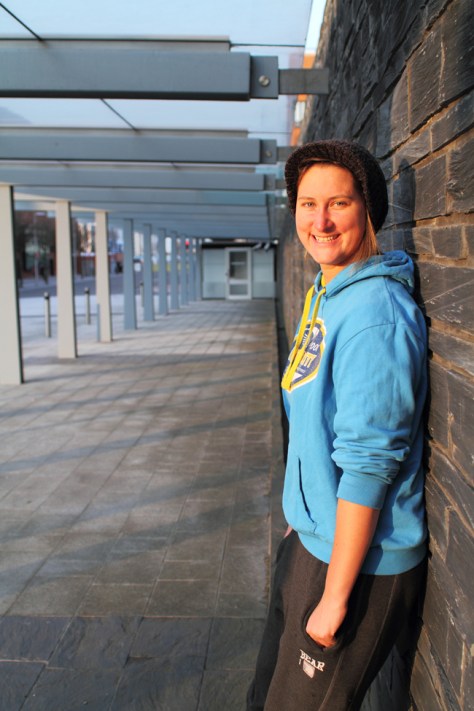
We Are Cardiff - Bethan 015W.A.C. Bethan large jpegs

“Nai byth fynd i fyw hefo’r hwntws!”

Dyna ddudish i amsar maith yn ol. Wedi deud hynna, mi nesh i hefyd ddeud y baswn i byth yn mynd i fyw i ganol Saeson cyn i fi symud i Lundain am 8 mlynedd!

Caerdydd. Fel Gog sy’n siarad Cymraeg ma’ gin i ddewis o fyw mewn 2 Caerdydd- un Gymraeg, llawn barddoniaeth, Clwb Ifor Bach a chanu mewn cor cymysg. Neu yr un sy’n llawn pobol o bob tras, hil a iaith, yn amrywiaeth o straeon a llwybrau bywyd.

Dwi ‘di dewis yr ail.

Dwi’m yn saff pam ond dwi’n gofyn y cwestiwn yn y gerdd isod.

Pam lai?

Does na’m cyfieithiad i’r Saesneg
Dio’m yn golygu run fath.
Dau air syml iawn
Ond yn ateb perffaith I lot fawr.

Pam lai?

Llundain- y lle mwya’ unig yn y byd
Ond alli di byth fod ar ben dy hun.
“Why don’t we move to Cardiff?”
medd fy nghariad.
‘Ia. Pam lai.’

Ty i jesd ni’n dwy,
Gardd i neb ond ni,
Gallu cerdded i bobman
Pawb yn deud “hello”
Ond neb yn deud ‘helo’.
Prifddinas Cymru i fod.
Lle ma’r Cymry Cymraeg?

Ma’ nhw yma,
Mewn grwpia’
A ma’ na groeso cynnes i fi.

Ond be’ am fy nghariad?
Oes ‘na groeso iddi hi?

Dwi’m yn cau drysa’
Dwi’m yn un am ddal dig
Ond dwi’n ysu
I ddysgu
I wybod mwy am y byd.
Dwi ishio gwrando ar leisia’
Ar ieithoedd dwi’m yn ddalld
Byta bwyd sy’n hollol ddiethr
Dwi ishio byw!

Prif ddinas adra? Ella.
Ond ma’ hi’n ddinas newydd i mi.
Dwi’n barod am antur
Am newid
Bring it on!

Troi cefn ar fy mamiaith?
Na. Byth. No we.

Profi rwbath newydd?
Ia. Pam lai?

Bethan’s obsession lies in people’s steps- how they got to where they are and why they act the way they do? She casts judgement aside, gets rid of right and wrong and delves into that dark, grey area to find what makes them smile. She was raised in North Wales, went to London to train as an actress and finally found her place as a writer. Theatre credits include The Beach (National Theatre Wales), Patroiophobia (Sherman Cymru) KKK (RSC) Come to Where I’m From (Paines Plough). Her online credits include Such Tweet Sorrow (RSC), Cei Bach (S4C) and Hatty Rainbow (You Tube). Bethan’s latest play ‘Unprotected’ will be on at the WMC on Dec 8th and 9th. Che currently lives in Canton.

Bethan was photographed at the Senedd in Cardiff Bay by Simon Ayre

***

“Riverside farmers’ market began with a dozen stalls, once a month” – Steve

steve-garrett-web

I was born in Wrexham in 1950, so I am one of the ‘sixties generation’ and still shares its values.

I’ve always loved markets, and after living in different parts of Europe and Canada, I came back to Wales in 1993 to work at Community Music Wales in Cardiff, carrying in the back of my mind the idea of setting up a farmers’ market here.

I spent a year at the School of Social Entrepreneurs set up by Michael Young who also set up the Consumers’ Association and Open University. The idea of the course was to learn to be “business-like but for social benefits”. At the end of that course I was ready to put my dream of running a farmers market into motion.

I set up Riverside farmers’ market in 1998, pipped to the post by a couple of months by Bath farmers’ market to being the first in Britain.

It began with around a dozen stalls appearing once a month, then went weekly, and eight years ago moved to its present site on the Taff embankment opposite the Millennium Stadium.

The idea of setting up a market really inspired me because it has an economic dimension, a social justice dimension, environmental and cultural dimensions. The social and personal sides of the market are just as important to me as the fact you can buy good food there..

I am disappointed that farmers’ markets are still perceived as being for a limited number of people, the affluent or those with high level of education.

But I think that the food landscape is about to change massively.

Food production and distribution is highly dependent on oil, and as oil becomes scarcer, the intensively farmed and imported food we buy through supermarkets will become more expensive and the alternatives relatively cheaper. Local food markets are going to slowly but surely become a much more important part of the food supply for everybody. In the meantime we’re trying to make sure there’s enough of a small scale agricultural economy in Wales while the bigger picture is changing.

Much of the food on sale at the farmers’ market is competitive with supermarket prices anyway, but we have been hypnotised in this country to think when it comes to food that cheap is good in a way the rest of Europe has not. My experience of France, for example, is that people are not buying sliced bread, they’re buying a fresh baguette and some nice cheese.

They may be spending a bit more of their income on that but we’re talking about quality of life here. It’s what you choose to do with your money. Health, quality of life, being part of a community are as important as anything else. If people spent a little more of their household income on food, as they do in many continental countries, they might value food more.

In this country between 20% and 30% of what people buy gets thrown away. If you buy vegetables you can have fantastic food really cheaply if you make it yourself, and it’s a pleasure to cook if you know how to. And it’s healthy for you and your kids to eat stuff that’s been made from fresh.

If I go down to the Riverside market I can never spend less than two hours there because I have to chat with all the stallholders. They’re really interesting characters because they’re all individualists.

Other activities, which have been part of Riverside’s work since the early days, include work with local schools, taking schoolchildren to farms, and running cooking sessions in the local community.

We also run a community allotment garden in Cardiff and have rented some land in Cowbridge to create an organic horticulture business that will be growing and selling food locally and training people to grow their own.

I think that good businesses of the future will be need to be more environmentally sound and based on collaboration than competition. It’s a change of culture. That makes me happy because that change of culture is precisely what the ‘60’s generation always wanted to achieve.

Steve Garrett oversees Riverside Community Market Association (RCMA) and its associated activities, including setting up three other farmers markets in Cardiff; education and outreach activities (including the Riverside Community Allotment) and the RCMA Market Garden project, a new social enterprise, which will provide training in horticulture for local people and help create a sustainable food chain in Cardiff. He sits on panels and committees that advise local and national government on food policy, and hopes to contribute to a more sustainable and future-oriented food system in Wales. In the little spare time he has, Steve plays guitar and gigs under the name of Stainless Steve. He is proud father to an eight-year old son who keeps him on his toes, and he is governor at Severn Primary school. He currently lives in Riverside.

Steve was photographed at Riverside Farmers’ Market by Adam Chard

***

‘I’ve loved Cardiff’s arcades for as long as I can remember’ – Amy

amy_davies_web

It took me five years to fall in love with Cardiff. Maybe I’d been in love with it from day one, there was certainly some kind of mysterious force keeping me here. But I only realised how hard I’d fallen a few months ago.

I’m not a native Cardiffian. I’m not even Welsh (although for some time I did believe I had Welsh grandparents…). I moved here for the same reason I imagine many thousands do – university.

The strangest part about my decision to move to Cardiff was that I’d never even visited the city before I agreed to come and live here. It just seemed like the right thing to do. So up I rocked on day one, no clue where anything was, no clue about the history of the place, just sureity that this was where I was meant to be – and thankfully, I was oh so right.

Fast forward five and a bit years (and it really does feel like fast forward) and I can’t imagine myself living anywhere else. Even after I graduated and got a job in Bath, 50 miles away, I took the decision to commute rather than move. Now, while commuting has the odd strange benefit, believe it or not, it’s not exactly a picnic, so what is it about this place that still keeps me in its clutches?

I probably don’t need to tell anybody reading this about the many marvels of Cardiff, but I think it’s only now that I’m not a student and I actually spend a lot less time here than I used to, that I really appreciate it for what it is.

I’ve ended up with a city centre flat surrounded, pretty much, by all the things I love. I have the wonderful Bute Park only a few minutes round the corner, the magnificent Castle is opposite and the extra special Victorian and Edwardian Arcades line the street I live on – I couldn’t really ask for more.

The funny thing is, a lot of the places that I love, I didn’t really discover until after I’d made the decision to stay here after graduation. It sounds blasphemous, but it took me until last year to discover Wally’s – if you can believe that – I’d walked past it a few times but for god knows what insane reason not been in. Jacob’s Antiques, just behind Central station is another place that I often find myself in on a lazy Saturday afternoon, shamefully again something I’d seen from the train window a million and one times before I actually went in.

I could go on (and on) and list a thousand other great places, but I simply wouldn’t have time, because there’s too many, and you probably already know about them. Suffice to say, now that I know what I’d be missing out on if I left, I’m more in love with the place than ever before, and I also know there are so many more gems that I’ve probably also missed just waiting for me to explore.

It’s my love of all things Cardiff that led to the sudden lightning bolt of inspiration I had just the other night. I’ve been taking part in a Project 365, where you take one photo a day for a year, when I casually strolled into the Morgan Arcade one evening looking for that day’s picture. I’ve loved the arcades for as long as I can remember, and I think it’s fantastic that there’s a place that’s so uniquely Cardiff literally on my doorstep.

I tweeted that it might be a cool idea to do a photography project based entirely around the arcades and since then it has snowballed, there’s been a lot of interest and it’s now a full-blown project. So now you see, I really can’t leave, because I’m committed now to seeing through my Arcades project develop into something that I can be proud of, and it’s hopefully something that other people will get a lot of enjoyment out of.

So that’s my story, in a very tiny nutshell. I wonder what else Cardiff will ensnare me with over the coming years? Whatever it is… I can’t wait to find out.

Amy Davies is a journalist and photographer living in Cardiff city centre. Having moved to Cardiff 5-and-a-bit years ago for University, and never having the decency to leave, she now calls it home. During the day she boards the train of fun for her daily commute to Bath working on a photography website, and most of the rest of the time she’s either taking photos, writing things, baking cakes or a combination of all three. Visit the Cardiff Arcades Project website for more details on her latest project of insanity.

Amy was photographed at Cardiff Castle by Adam Chard

***

“Laser, smoke machine, and two spinning turntables” – Doug

doug_nicholls_web

It finally dawned on me one day last summer that I think of Cardiff as home and have done for quite a while. It seems obvious now but it took a rare visit to the village that I grew up in to make me realise quite how much of an impact this city’s made on me.

I was back in England for a friend’s wedding and felt detached from the once-familiar surroundings. The accents didn’t sound right. Road signs were monolingual. I was a long way from the coast. People weren’t wearing pyjamas in supermarkets.

It was late last century when I first drove a car-load of belongings over the Severn Bridge with no idea of whether it would be a temporary or permanent move. To put a historical perspective on it: it was around the time the National Assembly for Wales was established, the Rugby World Cup was about to come to Wales and Cardiff Bay was preparing to open for business. As with many things in my life it turned out alright, more by luck than judgement.

Things were happening here. The promptly-constructed Millennium Stadium brought FA Cup finals and other major events to Cardiff while an over-budget, delayed Wembley Stadium was under construction. Cardiff City developed from third division mediocrity to Premier League hopefuls. Just last year the Swalec stadium put the Wales back into England and Wales cricket as the Ashes came to town.

Things outside the sporting world were gathering momentum too with gigs, clubs and daily trips to the basement at Catapult Records to keep tabs on new releases. It wasn’t long before I was immersed in music in Cardiff and I loved it. One of the main things that struck me about the city then – and it still does today – if you want to get involved, you can. This is where a compact capital city has its advantages.

I found my own slice of Cardiff, promoting and playing records at one of its true gems, Clwb Ifor Bach. It was one of the first places that really defined Cardiff for me when I arrived here. I managed to get a foot in the door, helping out at the now-defunct Hustler Showcase events and ended up doing a five-year stint with monthly club night Sumo.

Those heady days may be behind me but I still love that place. Guest DJs loved it. I’m guessing a few other people did too because they kept coming back each month: laser, smoke machine, and two spinning turntables.

Meanwhile, back in 2011, things are still happening here.

You only have to look to autumn’s Swn festival to see how well things can work in this cosy, friendly city. If anyone ever suggests that the ‘biggest bands’ don’t come here, the chances are they probably already have – and delivered a memorable gig to 100 grateful people in a city pub.

Whether you’re into music, arts, sports or something else, there are a lot of talented, creative, hard-working people in Cardiff and that won’t change any time soon. There are also a lot of people who know how to enjoy themselves. Often they’re the same people and that’s one of many things that make this city great.

Ten years after graduating from a journalism degree in Cardiff, Doug is still here and these days can mainly be found at home in Splott, at work for the Welsh Assembly Government in Cardiff Bay or running around Cardiff training for some event or other. Online: @dougjnicholls on Twitter or D_J_Nicholls on Flickr.

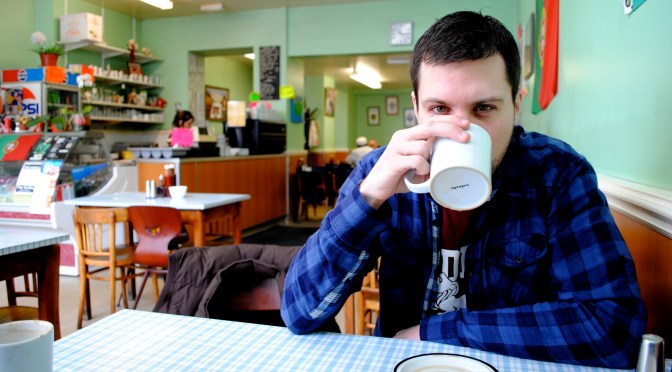
Doug was photographed at the Imperial Cafe by Adam Chard

***

“Cardiff Bay – what’s in a name?” – Jeremy

jeremy-rees-web

I get out and about in Cardiff quite a bit, it goes with the job. Unsurprisingly, then, I’m often asked the question ‘where do you live?’ It’s a fairly humdrum, commonplace way to initiate small talk. For some people the reply to such a query would roll off the tongue without a second thought. In my case though, it’s not such a straightforward matter….

For the record, I live in a terraced street in a cluster of Victorian houses near where the River Taff ebbs and flows its way towards the Bristol Channel. The houses on my street were built to accommodate the families of men working in what was one of busiest seaports anywhere in the world. The houses all look pretty much the same from outside, but all are built slightly differently – some quite considerably larger than others to reflect more senior positions of the inhabitants, with the Sea Captain’s houses being the largest. The house I live in is one of the smaller ones and was home to a docker’s family for 65 years. That family has gone, but the stories of their time here lives on in the memories of my neighbours who have lived on the street for decades. It’s a friendly and welcoming place to live; the community is richly diverse in ethnicity, and that’s nothing new – the area is part of what many regard as the oldest multi-cultural community in Britain. To those who’ve lived here for generations, this area is known simply as ‘The Docks’. Separated from what used to be Tiger Bay by Clarence Road, it’s a small enclave that survived both the bombings of World War 11 and the brutal bulldozers of Cardiff Corporation in the 1970s.

To call it ‘The Docks’ is a nod to its history, its heritage – to the stories of the people who lived and died here, but it can’t be denied that the name no longer reflects the area. What remains of Cardiff Docks is a good couple of miles away, and the only vessels we now see calmly making their way down to the barrage are yachts and the occasional Water Bus. Estate Agents have applied the term ‘Cardiff Bay’ to these streets for 20 years or more, and unsurprisingly that’s how many others of my neighbours describe where they live. The street is a stone’s throw from the heartland of ‘new’ Cardiff – the Wales Millennium Centre, Mermaid Quay, The Red Dragon Centre and the profusion of restaurants and arty shops that have transformed this once neglected part of the City into a thriving cultural hub. For me, though, all the impressively shiny newness is a stark counterpoint to what it replaced. The decaying but still majestic empty buildings at the top end of Bute Street and the abandoned railway station in the Bay are screaming out for investment while new constructions – which could be anywhere in the UK – are still springing up.

As far as maps – and Cardiff Council – are concerned, I live in Butetown. The area of the City about which most books have been written, and which inspires reactions as diverse as the district itself from people who have never been here. It is in Butetown that Cardiff’s only community radio station has its studios. Indeed, Radio Cardiff is the only radio service exclusively aimed at the city. It’s an extraordinary operation. It receives no grant aid and employs no staff, but has a team of over 50 unpaid volunteers who put together programming that is quite unique and with a definite Cardiff accent. The team behind it ran short-term restricted licence broadcasts (under the names Tiger Bay FM, Bay FM and latterly Beats FM) regularly from 1992, and then in 2007 succeeded in winning the licence to broadcast the full time ‘Radio Cardiff’. I joined at its official launch, first as a newsreader and then as a presenter. Now I co-ordinate the volunteers who produce the news output and a youth programme. I also present the Saturday Breakfast Show. It’s more than a radio station for the community, it’s a community within itself – multi-cultural and across age ranges. I have learned so much from being part of the team there, not just about radio but about the city in which I live. I have been privileged to meet – and often interview – many of the people who have contributed to make Cardiff what it is today.

So, just where do I live? I totally respect the idea of referring to my area as ‘The Docks’ but in truth it’s a name that reflects a time I wasn’t here and so it doesn’t really feel right. I’m not a ‘Docks Boy’ – I grew up in the Swansea Valley and lived much of my adult life in London so while I love hearing the stories of its past, they are not my stories. I’m uncomfortable with calling it ‘Cardiff Bay’ perhaps because of what was cleared away to create it – it’s still raw for many who grew up in Tiger Bay that the unique community that meant so much both to them and to the city could have been swept away by a planners blueprint. I have no problem with the name Butetown other than it refers to the larger district, and so whatever the Post Office may say, I live in ‘The Bay’,

Jeremy Rees works for Voluntary Action Cardiff, – the organisation supporting charity & voluntary organisations in the City – and at Radio Cardiff where he presents ‘Soulful Saturday Breakfast’ every Saturday morning 7am-9am. He currently lives in the Bay.

Jeremy was photographed at the Radio Cardiff studios by Adam Chard

***

“I Heart Bute Park” – Lisa

lisa-derrick-web

I’m very lucky to have my favourite place in Cardiff so close by. Living in a flat means I don’t have any green space to officially call my own, but Bute Park provides all the leafiness I need just feet from my front door.

I lived in Hirwaun, a little valley village, until eight months ago when I made the move to Cardiff. Back there, I had a little garden complete with mountain views, and whilst I often cursed its inclination to grow wild and unruly within seconds of my secateur attacks, it was a place of solitude, a tiny slice of grassy-ness where I could read, drink a cup of tea or glass of wine, or even just watch from the shelter of the house as rain hammered down or snow softly fell.

I’ve always spent lots of time in Cardiff. I spent years driving back and forth to and from Hirwaun for gigs, films, friends and the like before deciding to take the plunge and move. It has made my social life much easier!

As much as I now love being amidst music venues and coffee shops and cinemas and pubs, I feel a shot of nature is needed to stay sane, some natural surroundings necessary to counterbalance the city silhouette.

Bute Park provides exactly that.

Early morning runs become more pleasurable when exercised within its environs, the foliage and flowers and the glistening River Taff providing stunning distractions. The same features soothe and calm on a summer’s day when a blanket can be spread on the grass, under a tree, or river side and the day spent with wine, words, chocolate and conversation. When the rain falls or the wind blows, the park’s beauty becomes slightly rougher, trees bend under the blustery breeze; rain is glugged greedily by the Taff. After a snowfall it transforms into a real life winter wonderland, a sparkling white layer spread all around. The park illustrates the seasons in an impressive natural artwork, something rarely revealed within a city.

Bute Park is a place for activity or introspection, a place to go with friends or family, a place to walk your dog or stroll solo. It’s a place of history, home to Cardiff Castle, the Gorsedd stones and the Animal Wall.

Initially developed in 1873, the park was later presented to the council in 1947. Hundreds of thousands of people have passed through it over the years. It’s a place where the energies and histories and souls of the Cardiffians gone by can be felt, as well as the stories and passions and secrets and longings and evils and regrets of the contemporaries.

It’s a place that inspires me to write, which provides a platform for my fitness attempts, which allows me to think, and gives me that shot of nature needed to stay sane. I feel very lucky indeed to have Bute Park on my doorstep.

Lisa Derrick is a Development Officer for a community arts project in Merthyr Tydfil. Lisa won runner up place for best writing on a blog at the Welsh Blog Awards in 2010, you can read The Chocolate Takeaway here and find her on Twitter @lisajderrick. She also writes for Plugged In Magazine and has published articles on the Guardian Cardiff site. She is currently studying part time for an MA in English and Creative Writing at UWIC and has novel shaped hopes for the future. She currently lives in Riverside.

Lisa was photographed in Bute Park by Adam Chard

***

“Cardiff, city of new height. Capital of Wales. Darling of the valleys. Principal shopping magnet for all of western Britain – opened a year too late” – Peter

peter-finch_web

I’m in the lozenge-shaped city again. It’s the one I come from. Where I was born and where I still live. Water south, hills north. A city of rhomboid sprawl. Where else would I be? I’m standing on the B4487 in bright early-morning sunlight. Traffic low. Birds in inner-city twitter. This was the Via Julia Maritima once, the paved Roman route west. A thousand years on it was the stage coach route to London. Full of ruts and mud. Then it was the hard-topped A48, when A roads meant something. Newport Road when I was a kid. Still is. The Africans are walking down it now. The endless displaced. Heading up beyond Roath Court for the Refugee Council at Phoenix House. Fewer now that the recession has hit. Polski Sklep having a hard time. The Czech shop already closed.

We always wondered why in this place there was so much new housing. Apartments rising like corn right across the boom city. Concrete mixers. Deliveries of brick. Tower cranes like locusts. Men in hard hats in every bar. What drew them to this capital? What were we doing that made them come? Nothing, it turns out. Investors are blind. Invest where walls rise and your money will climb in step. No need to sell what you’ve built. Let the vacant towers glitter. Let their apartments stand empty, value accumulating as prices soar. Manage a let if a visitor asks. Sell one to an executive needing a town centre toehold. Rooms with a water view for singles. Wasp territory. Audi in the undercroft. Wine in the rack. Families not needed. No toy cupboards. No gardens. No schools.

Now that boom has bust these investments stand barren. For Sale. To Let. To Let. Those not yet completed stay so. A city half-finished. For now.

Yet the centre flourishes. Come here on a match-day to see it at its peak. Street theatre, music, men on tightropes playing violins, Roma bands with clarinet and double bass, student duos with bright guitars, the Red Choir – some of them sitting now – still ushering in freedom outside the covered market, Chinese selling me my name bent in wire, Ninjah in bling and Sgt Pepper Jacket beating rhythm on the street furniture. The Big Issue seller with his dog in costume. The Coptic Christians. The Gaza protestors. The shaved heads of the Hari Krishnas weaving through the crowd. More vibrant life on Queen Street than at any previous time in its history.

St David’s 2 – the comprehensive redevelopment of those parts of the centre unscathed by previous interventions – hit the concrete mixers in 2004. Not only were the broken wrecks beyond Hills Street and all final centre traces of Victorian Cardiff wiped but much of Cardiff’s seventies restructuring along Bridge Street and the Hayes went too. Twenty-five years was as long as Iceland and the new library lasted. St David’s, because he is our patron saint and a Welsh symbol the world will recognise. Cardiff, city of new height. Capital of Wales. Darling of the valleys. Principal shopping magnet for all of western Britain. And in terms of the boom, opened a year too late. Vacant lots waiting for the fall to bottom. The recession has taken the gilt. I went through yesterday. Brave faces. Glass and just that little bit of echo. Promise not yet completely fulfilled.

Back on Newport Road it is as if the fifties are still with us. Victorian three-storey housing still in need of a repaint. Bed and breakfast vacancies. Hopeful signs saying that Construction Workers are Welcome. En-suite at no extra charge. Chip shop at the end of Broadway selling Clarks pies. Someone removing their front wall so that they can park their car in their front garden. Couple of kids on skateboards. Nigerian with an iPod. Man on a bike, no helmet. Cardiff as it was, still is.

That’s why I live here. Because Cardiff is. This piece is adapted, cut, spliced and mashed from Real Cardiff Three (Seren Books) – part of my on-going obsession with the city in which I was born. Check http://www.peterfinch.co.uk/cardiff.htm for more.

Peter Finch is a poet and psychogeographer who lives in east Cardiff. His latest collection of poetry, Zen Cymru, was published by Seren this year. He runs Academi, the Literature Development Agency for Wales.

Peter was photographed in Cardiff Bay by Adam Chard

***

“Cardiff is on the cusp of something quite brilliant” – Matt

matt-williams_web

I grew up in Aberystwyth and had spent most of my childhood, teenage and adult years there – I moved away for a short period during university to study in Canada, but I’d never been away for longer than seven or eight months at a time – so moving to Cardiff is probably my first big break away from home. I probably shouldn’t be admitting this at close to 24 years old.

I’ve felt close ties to Cardiff for a few years now. Many of my school friends ended up here and I was a fairly frequent visitor for that reason. During university I also managed to form some ties with the Cardiff music scene – inviting a few (locally) renowned Cardiff bands to play in dingy back-rooms in Aberystwyth and travelling down here on a semi-regular basis for gigs.

I finally moved to Cardiff in June 2010 after having spent six months travelling to and from the city to spend the weekends with my partner. Moving here had been in the pipeline for over a year before I finally made the move – Hannah and I had agreed that we would both move here once she’d finished a number of internships abroad, it seemed like a logical place for us both to look for long-term employment. However, it took me quite a long time to find work, especially as I had a good, secure job in Aberystwyth that I didn’t want to abandon for something less appealing. In the end I’m glad I held out to find a job I wanted, as I now have the privilege of doing a job I enjoy at Positif Politics. I work with a great group of people and it’s an exciting time to be involved in public affairs/politics – what with the Assembly elections in May 2011, and the vote on further powers in March.

I have a fantastic cycle route to work through Bute Park and along the river, and it’s a brilliant way to wake up in the morning, and to finish off the day – though with the nights drawing in I shall once again be relegated to the dreariness of a commute on my beloved Cardiff Bus (that’s a lie, we really don’t get on very well at all but there’s another story for another day). I feel privileged to live in a city with so much green space, I live almost exactly halfway between Bute Park and Roath Park and there are plenty of other spots to go hide in scattered around. The city is also surrounded by beautiful countryside – the view from Castell Coch is one of my favourite in the world.

Cardiff is also giving me the opportunity to further indulge my love of music. The annual Swn festival is a great chance to enjoy music around the city in a condensed format – it was brilliant fun this year. Going out to gigs in different clubs and pubs has allowed me to meet some interesting characters and make some fantastic new friends.

Cardiff seems to be a great place to be for music at the moment, I feel like the city is on the cusp of something quite brilliant with a number of fantastic bands beginning to emerge and a seemingly thriving community-based approach to the arts and culture. My particular favourite of the current crop of Cardiff based bands (like so many others) are of course the wonderful Islet. But the hard work and dedication of so many others is really at the heart of what is going on, and for that I thank all the citizens of Cardiff who try so very hard, and more often than not succeed in making this city a wonderful place to live and work. Apart from the buses. I hate the buses.

Matt Williams is 23 and a bit years old and lives in Cathays with his partner Hannah, close friend Grace and two Guinea Pigs, he works at Positif Politics in Cardiff Bay and tweets at @mdwaber, he can also be found online at LastFM. In his spare time he tries to attend as many gigs as humanly possible and dances badly to loud music wherever he can find it. He can also often be found somewhere in or around the city exploring on his bike.

Matt was photographed at the Pierhead in Cardiff Bay by Adam Chard

***

“We all gravitate back to Cardiff” – Cerys

cerys_furlong_web

I grew up in a small village eight miles outside of Cardiff. Cardiff was the big town we were allowed to get the bus to on Saturdays. The last bus home on a Saturday was ten past five! One of my last school trips in primary school was to Cardiff Bay- “Europe’s most exciting waterfront development”- the slogan sticks in my mind with the image of remaining piles of coal and remnants of industry amongst promised development. A few years later, along with my friend Paul, I was a school-rep on Cardiff Council’s Young People’s forum. We only went for the free sandwiches and time off school. At the time County Hall, Atlantic Wharf was virtually the only new building down the Bay. Little did I know then I’d be spending so much time there.

While I have amazing memories of Cardiff as a child- being smuggled into rugby matches at the Arms Park under my dad’s jacket and picnics in Bute park stick in the mind- by the time it came to go to university I knew I wanted to be somewhere else, learn new neighbourhoods, and new people. I only went as far as Bristol, but it was so big, so different, so vibrant and mixed –I still miss it sometimes. But strangely, being in Bristol only strengthened my love of Cardiff, and Wales.

I’d said I’d never come back, I probably sneered slightly at my friends who never left. A year or so after graduating I got a job working for an MP in Bristol. Although I’d grown up with actively Labour parents, and been a member of the party as a teenager, my membership had ‘actively lapsed’. Politics was far from my mind in Uni. I’d marched against the war, voted green, maybe even voted lib dem. It didn’t matter to my boss that I wasn’t a party member- she must have seen it in me. After a while, I wanted to do further study. I was really interested in the things going on in Wales, in Cardiff. Since I’d been away the Assembly had been established, there seemed a new momentum and purpose in Cardiff- like it had begun to realise its identity as a capital city.

I’d never actually lived in Cardiff, only in the leafy privileged green belt. It was exciting looking for somewhere to live, from Splott and Roath to Llandaff North and eventually Canton. I remember house hunting- we kept getting confused between City Road and Cowbridge Road East. Seems ridiculous now, but although I’d always said I was from Cardiff, I realised I didn’t know its geography, the short cuts, the hidden gems. I landed on my feet and have loved Canton ever since. I love living in a neighbourhood where you can walk to work, to parks, the shops, and back from town at two in the morning when it seemed like a good idea at the time. And I love living in a city where as well as all those things, you can be on the beach, in the mountains, or the rolling countryside in within half an hour.

Maybe a little bit of me felt like a fraud when I decided to stand as a Councillor for Canton two years ago- I’d only been living here for five years. But then it’s a neighbourhood where people do come and go, a mixture of old and young, new radicals and die-hards Cantonians. And now my home, and that of my family.

Friends from other parts of the UK still can’t quite understand how we still have such a close knit group of friends from home, from school, from Cardiff. That’s the thing you can’t pin down. We all gravitate back to Cardiff- we don’t want bigger, maybe we don’t even want edgier- it’s our comfort zone, I’m proud to say my comfort zone, and I salute you for it Cardiff.

Cerys lives in Canton, Cardiff. She works for the National Institute of Adult Continuing Education (NIACE) and is a Labour Councillor, representing Canton since 2008. Cerys has worked in education for the last six years, and been an active in Labour politics for far longer. You can follow her on twitter @cerysfurlong. She has one daughter and currently lives in Canton.

Cerys was photographed at Canton Library by Ffion Matthews

***

“I’m definitely not English and I couldn’t claim to be Welsh, but I do think of myself as Cardiffian now” – Noreen

Noreen by Ffion Matthews

I ended up in Cardiff by chance, really. I grew up and studied in France, and after doing my MSc research project at Aberystwyth University, I stayed in the UK to work. Various jobs and secondments took me all over England and Wales, until I found myself in Cardiff, and liked it so much that I stayed. It’s the place where I have felt most at home and where I can see myself putting down roots. I guess I’ve started doing that already!

I’m a city girl and I couldn’t live happily somewhere without theatres, cafes, and shops that stay open after 5pm. Because Cardiff’s a capital city, it’s vibrant, and has gigs, exhibitions, shows, workshops… There’s always a variety of things to do. It’s got great places to hang out and chill too. And it’s got the parks! I love Bute Park, walking past the Animal Wall to get there, and hula hooping near the stones. They’re such an easy landmark to meet people at, and, well, they’re standing stones, which is cool. This is the capital of a country that had Eisteddfods and bards and song and poetry as national traditions and institutions – and it’s woven into the fabric of the city.

I’m half Chinese from Singapore and also French and I like that Cardiff is fairly multicultural; also that the population is young because of the Universities, even though it means Friday and Saturday nights in town are a nightmare of rowdy drunken students. But hey, that’s part of what makes this city what it is. Despite the usual high street shops that are the same everywhere (and although I mostly moan about them, sometimes they’re convenient because you know exactly where to get what), the centre has a nice distinctive feel. Cardiff’s got a bunch of independent shops and also the arcades. I spent my teenage years in Paris, which has a number of arcades right in the centre, and I love them. It’s a shame about all the empty shops there – I would like to see them more alive and better used.

I’m a sucker for architecture and nice buildings, and that’s another reason why Cardiff appeals to me so much – it’s not just the WMC and the Senedd down the Bay: there is a great mix of beautiful buildings in town, and I love wandering around early in the morning or late at night, when there are no crowds of shoppers to dodge, and walking “with my nose in the air” as the French say, checking out the facades and rooflines we ignore on a daily basis.

Despite being the capital of Wales, Cardiff is a small city. It’s small in size, so that I can walk or cycle most places – and it’s pretty flat! Cycling around Cardiff makes me very happy indeed. It’s also small in population (well… for a capital city anyway) and I have found here a real sense of community and friendliness. Cardiff is like a village where when you meet someone, you can be pretty sure they’ll know at least one other person you know. I like that. I think that’s what’s contributed to my feeling settled quicker than in other places I have lived, and building a strong network of friends in a couple of years after I arrived – and that’s why I feel so settled now!

I’m definitely not English and I couldn’t claim to be Welsh, but I do think of myself as Cardiffian now. It would take a big event indeed to prise me away!

Noreen Blanluet is a self-employed creative business consultant, helping entrepreneurs and freelancers to take their business and their life to the next level. You can find her at www.beamazingtoday.co.uk and on Twitter @beamazingtoday. She’s living in Splott at the moment and is pondering moving to Roath early next year. Longer-term, her aim is to move to the house of her dreams in Cathays.

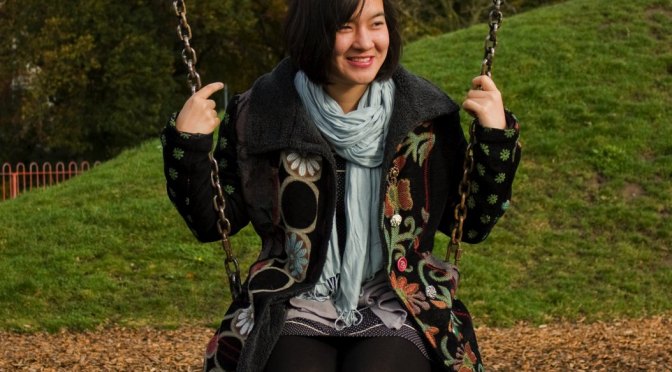
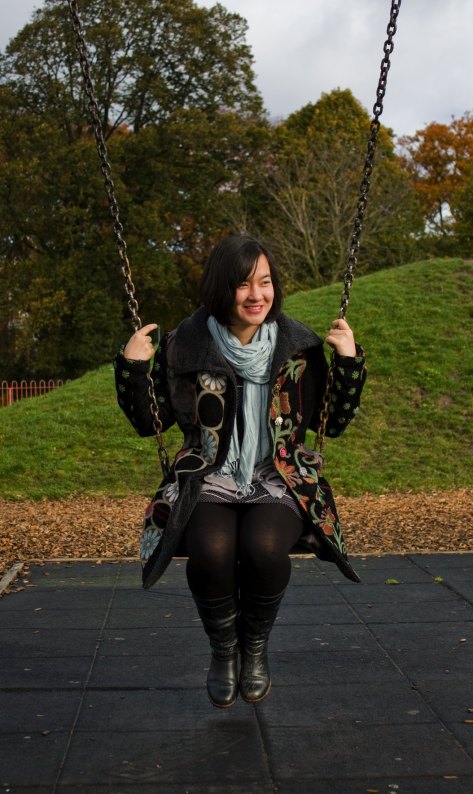
Noreen was photographed on the swings at Roath recreation ground by Ffion Matthews

Noreen by Ffion Matthews

***

“Thirty years on, I’m still here, and my identity has changed as much as the city itself” – Dave

The Cardiff I moved to in 1980 was a very different city to the one we know today: no Cardiff Bay, no Millennium Stadium, no St. David’s Centre (1 or 2) etc. etc. My job had relocated from London and, having no Welsh roots or connections, initially I felt like an outsider. But four employers and thirty years on, I’m still here, and my identity has changed as much as the city itself – I now can’t envisage ever living anywhere other than Cardiff, and I feel far more Welsh than English.

It would have been possible to live and work in Cardiff, to bring up a family here, and yet continue to identify with my country (or county) of birth. I know contemporaries who have done just that, whether by choice or by chance. The catalyst for me, though, was sport – football to be precise.

During the eighties, not content with being only a long-distance supporter of my home team (though I will never abandon them), I started visiting some of the local clubs in south Wales. It was the era of the ‘fanzine’, the publishing boom of those pre-internet days, and I contributed the odd article on Welsh clubs to various publications; in time I became a Welsh correspondent for a couple of titles, now long-defunct. Travelling around Wales every Saturday, visiting places and meeting people I would otherwise never have come across, I developed a sense of belonging in Wales.

Twenty years ago, just as Wales was re-asserting its national identity in many walks of life, I was persuaded that Wales needed its own football magazine. Little realising how much of my spare time the project would consume, I was also persuaded to get involved. With our own funds, a few of us launched a modest little publication called Welsh Football in 1991, and 143 issues later it’s still going, a niche, not-for-profit publication admittedly, but our national football magazine nonetheless. It’s just a shame that, nineteen years on, it’s still so hard to raise its profile amidst the blanket coverage of English football here – new readers regularly tell me “I never knew it existed”. And even worse, since Borders bookshop closed, we don’t currently have a retail outlet stocking the mag in the capital city !

As Welsh Football’s unpaid editor, feature writer, photographer and many other things, I still travel around Wales on a regular basis, meeting friends old and new. Though I put in a lot of time (and sometimes money too) what I get out far outweighs it: not just enjoyment of the games, but appreciation of the variety and beauty of Wales, and above all a sense of identity: yes, after spending more than half my life here, I definitely consider myself Welsh now (and I think I’m widely accepted as such by my native Welsh friends and acquaintances, too). And I even pass the acid test: when Wales play England, there is no way I can cheer for the ‘three lions’!

Dave Collins is an IT consultant. He also publishes Welsh Football magazine (‘the National Football Magazine of Wales’), a not-for-profit magazine written by, and for, lovers of football in Wales and published eight times per season. The magazine is available by subscription – see http://www.welsh-football.net or email welshfootball@lineone.net for details. He currently lives in Rhiwbina.

Dave was photographed by Simon Ayre

“My city has its ups, my city has its downs … bad boys, and bad girls, geniuses and clowns” – David (Verso)

versosmall

I was a babe in arms when I first came to Cardiff; however, my very first memory of it was when I was sat in the window seat of a bus going down a then almost squalid ‘Cathedral Road’. I distinctly remember asking my mother why all the lovely houses were boarded up.

My parents met at a dancehall down the docks. My father was a boy from the Merthyr Valley; born of Welsh, Irish and French descent. On my mother’s side of the family I inherited African, South American Indian, Italian, Irish and English; so to say I am mixed race is a bit of an understatement. However, I am a proud and patriotic Welshman and Cardiffian, along with the rich multi-cultural genetic rainbow of nationalities within me. It is worth noting the word Welsh is actually an Old English word meaning “foreigner; slave” and at first was applied by the Anglo-Saxons to all the native peoples of Britain.

I detail the race and cultural accent here because that is what makes me especially proud of Cardiff as a place unlike most others. I once spoke to a Nottingham born second-generation Pakistani man who could not believe his eyes on seeing that Sikh, Indian, Bangladeshi and Pakistanis were friends and next-door neighbours.

It may be of little consequence to the average white native, but for a man of another race, it does make a significant difference.

Cardiff is like a village that happens to be a city; and a county that feels like a country. Not that it is apart from the rest of Wales, it’s just that there are representatives from all parts of Wales, mixed with a lot of English, Irish, a broad mixture from sea-faring nations, and now from every corner of the globe. Such diversity enriches the experience of both dweller and visitor.

For some, Cardiff is like a practice for London or another city; and for plenty of others, a perfect place to settle. Many students end up staying for many years after their studies are complete; if not for the rest of their lives. Cardiff is a place that people return to; not run away from.

There’s something here to remind them of home, and many more things that their last home can never have. Although Cardiff is the hub of the creative and financial industries, it is unlike London; thankfully. People still smile and say hello, give you the time of day. They still say please, thank-you and excuse me… well, usually ;). It is a place where you can find enough people alike yourself to feel a part of a movement / tribe / community … from artisans to anarchists.

I love the stunning parklands throughout the city; and a real jewel of the inner city that is the oasis of Bute Park.

Also, the stunning and varied coastline and wild national parks all around us within walking/cycling distance; or a short train/bus/car ride away. Cardiff is a worldly city; despite its size and population. I would like to see it be ambitious and evolve to be considered among the best cities in the world. No city is perfect, nor ever will be. We have our share and experiences of the negative as well as the many positives. I recorded a song with a designer/musician friend, Matt Harris, which captures my perspective. It’s called, The City in Me (“My city has its ups. My city has its downs / Bad boys, and bad girls, geniuses and clowns”).

I was extremely disappointed when the winning design of Zaha Hadid was vetoed by the unimaginative old-order of councillors of Cardiff. The Armadillo is ok because of its nod to the industrial past. But we’ve been there, done that, and got the postcards. Neither am I too keen on the lack of creativity down at the homogenised, indistinctive Cardiff Bay.

What about the future? I would love to see our city reaching boldly into the future, rather than just clinging to its past. My hopes are high though. There are a decent number of creative folk, and an entrepreneurial zeitgeist running through the city right now fuelling a new agenda that doesn’t depend on the backward thinking policy makers in the greasy seats of power and influence

David (Verso) is a poet for non-poets and poets alike, creator of wordplays like ‘Cardifferent’, singer/songwriter, dancer, artist, visionary designer, innovator, businessman in the making… procrastinator in the doing. Find him on Scrib and Myspace. He currently lives in Canton.

David (Verso) was photographed in Chapter Arts Centre by Adam Chard

***