Category Archives: The City

A trip up Asbo Hill (aka Asda Hill, aka Grangemoor Park)

For the past year, I’ve been writing a column for Caught By The River, exploring the River Taff. My latest piece veers off course from the Taff and heads for the land in between the Taff and the River Ely, a place known as Penarth Moors – unassuming marshland before being turned into a municipal dump in the 1970s.

Here’s the piece in full – Wandering the River Taff: A Detour

But as usual, there was loads of stuff I couldn’t fit in the shorter piece, so I thought I’d sketch out all my research here. This is the area I’m talking about.

This was taken on a sunny day in late autumn 2017 …

At the end of their river flows, both the Ely and the Taff dump their waters into the same large basin (formerly the estuary – now the grander container that has given its name to the area surrounding it: into Cardiff Bay).

As well as ending in the same place, the Ely and the Taff have other parallels. Both have suffered the same extreme pollution problems: declared “dead rivers”, flowing black with sewage, coal dust and industrial waste they had picked up from the heavy industry of the valleys they flow through. Thanks to regulation and a lot of effort, both are in better shape than they were, and are now home to a variety of flora and fauna.

Both rivers have also had their natural courses altered by man: each straightened in sections to better fit our urban plans. The Taff was straightened by Isambard Kingdom Brunel in the 19th century to build Cardiff Central Station, while the Ely was straightened over a century later – less glamorously, to create more space for the Ferry Road landfill site.

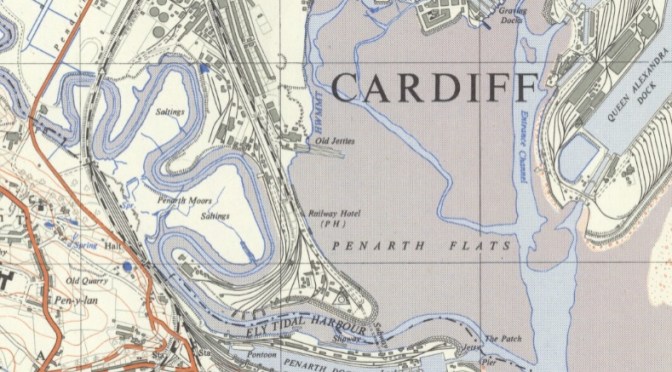
Here’s a map of the same place from 1956 (From this NLS Map: ST17 (includes: Cardiff / Caerdydd; Penarth), published 1956). Note the mad wiggling of the River Ely as it heads out towards the Severn and compare with the map above.

The Ferry Road landfill was created in 1969 when the Ely was straightened by cutting off one of its bends. The empty river channel became a hole for Cardiff to throw all its crap into. The city  soon outgrew this hole, and we started dumping our waste across the salt marsh. By the time the tip was closed in 1994, it was one of the biggest in Britain.

At the height of its seafaring power, Cardiff was the biggest port in the world. But the city’s decline in fortunes over the 20th century was so severe, the topic was debated in Parliament repeatedly. After years of discussion, eventually, in 1987, the UK Government created the Cardiff Bay Development Corporation, whose job was to improve or upgrade south Cardiff’s infrastructure and develop a plan for its future use. The Ferry Road and Ely Fields redevelopment was part of the much bigger project of building the Cardiff Bay Barrage, creating an artificial freshwater lake around the city’s waterfront area, covering 490-acres formed from the impounded waters of the Rivers Taff and Ely. It was a hugely controversial project, contested throughout its life. It still draws mixed reviews from residents.

The Cardiff Bay Barrage Bill only just squeaked through Parliament – you can read some of the debate (including discussion about what would happen to the Ferry Road tip) in the Hansard from 25 November, 1991.

Reading through the debate, you get a sense of the enormous complexity of the project. Regeneration of the area is of key importance … but much of the land is taken up by SSSI (sites of special scientific interest because of the flora or fauna). But for me, a key point is from Barry Jones MP (Alyn and Deeside):

There can be no doubt about the need for urban regeneration in the Cardiff docklands. The docks of Cardiff were at the centre of the coal-based prosperity of south Wales. Coal from the valleys of south Wales made Cardiff the world’s leading coal-exporting port. The decline of the docks has mirrored the decline of the south Wales coal industry. Now, with fewer than 2,000 workers in our pits, Cardiff docklands must find a new identity and a new prosperity. 

As part of the plans to improve the area, the Corporation proposed a new A road to link south and west Cardiff with the M4. The plan for this road – which is now the A4232, a road I drive on nearly every day – plotted its route straight through the middle of the tip. Once earthworks began, tipping was restricted just to the area to the north of the A4232. By the mid 1990s, this area towered almost 20 metres above the surrounding area.

If you’re interested in really getting into the detail of the area, this image is a 1960s aerial photograph of the area. It’s taken from a PhD submitted by a Cardiff University student in 2006: Development of Geoelectrical Techniques for Investigation and Monitoring of Landfills, by Andrew George.
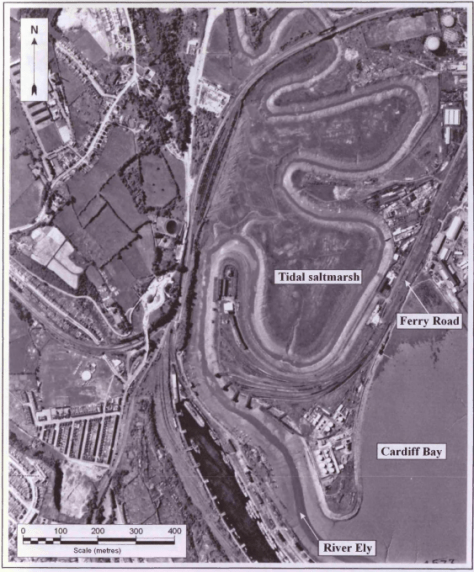
Fast forward through time to 1988, and you can see how the river was shortened through diversion, and filled with rubbish. This next image is taken from the same publication …

This 1988 air photograph of the Ferry Road area shows how far the landfill extended from the initial river channel. It also shows the proposed development route for the A4232 – right through the centre of the site.

This view is from inside Grangemoor Park today, underneath the A4232 flyover. It’s fairly quiet, apart from the cars tearing along overhead.

The A4232 neatly splits the site into its two locations: Ferry Road landfill to the north, and Ely Fields to the south. The land of Ely Fields used to be brickworks, rope works, storage depots and scrapyards. A different kind of ‘Elysian’ – a distinctly south Walian, industrial one. Memories of our industrial history – industries we can no longer support, now Cardiff’s not the port it used to be. So a tip was what it became: shovelling endless tonnes of rubbish onto our heritage: burying it deep, deep underneath the consumerism of the 1970s and 80s.

As I mentioned in my Caught By The River post, during its lifetime, the Ferry Road municipal tip amassed four million cubic metres of household and commercial refuse. The initial plan to move all this crap to Bedford by rail was poo-pooed in the end, and the Cardiff Bay Corporation instead decided to pile all the rubbish up in one place, add an impermeable layer on top (which is why the park turns into a bog whenever it rains), and create a city park.

The following image shows you the detail around the layout of Grangemoor Park, including the extent of the old landfill site. This was taken from The Reactivation and Remediation of the Landfill Site at Ferry Road by A. Phillips and H. Cherrill, in Geoenvironmental Engineering: Contaminated Ground: Fate of Pollutants and Remediation.
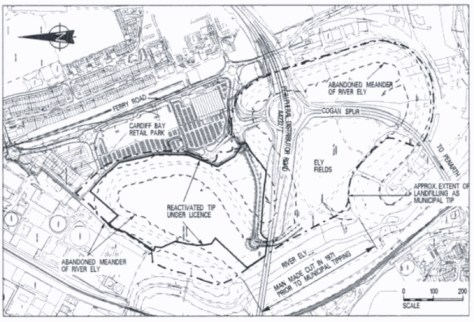
Whatever you think about out-of-town shopping complexes, I don’t think anyone would complain about having a park replacing a landfill. Would you?? Go on. Just try it. Urban wildlife flourishes here. There are butterflies, endless insects, skylarks and other birds. I’ve read that the pond at the bottom of the site has various species of newts, dragonfly and damselfly (although everytime I wander past the only thing floating around in the water is empty McDonald’s wrappers).

As well as the birds and squirrels I see on the site (and the rats and foxes my dog goes mad sniffing after when we walk), the site is also now being used for refugee animals being turfed off their homelands. In 2006, 850 slow worms were moved to the park from a local housing development (the new houses and flats you can see on the other side of Ferry Road). The slow worms have not only survived but babies have been found – apparently the mix of tall grass and small bushes is an ideal habitat for the worms. They like mosaics – of shaded areas where they can hide and rest, and areas which are exposed to the sun where they can bask and increase their body temperature.

Stand on the link artwork at the top of the hill. Look south. See rising lands ahead of you: this marks the edge of Cardiff and the start of the Vale of Glamorgan. Leckwith behind all the hills. And then the River Ely, gently winding around you.

The peaked building in the centre of this shot above is the charmingly named “Outfall Sewer Cardiff (Western District)” (known today as the Pumping Station or the Pump House). It was built in 1907 by engineer William Harper, who’s been mentioned in this column before (he designed and built much of modern Cardiff, specifically the Clarence Road Bridge, which I wrote about last time). This Edwardian Sewage pumping station is formed of a single storey yellow brick building with slate roof and six round headed bay windows with red brick arches. If you visit it today, your experience is a far more sanitary one: there’s a nice little cafe, and vendors dealing in antiques and collectibles in the 32,000 square feet of the place.

Back to the chain link sculpture at the top of the hill. Look down, right there, by your feet: the flatpack mixture of the same out-of-town shopping offerings you’ll find in any of these man-made hubs. It’s where you’ll find our Ikea – on weekdays, full of confused students whose parents are trying to help them kit up and grow up, as if adulthood comes flatpacked, accompanied by a set of tumblers and some candles.

But look beyond, to the north, beyond Ikea, to the maritime-inspired spikes of the Millennium Stadium. You see the city spread around you, like a glossy plastic puzzle that you could reach out to and move pieces around in. Closer to the lens, you see Cardiff, the buildings like tiny toys – for so long, the city kept from building upwards to “preserve the skyline of the city” (what skyline, you might well ask). Integrity now forgotten, they’re bollocking high rise up everywhere they can. The Millennium Stadium, the BT Tower. It looks like one of those pop up cards that show you the city you live in as a weird, 3D-2D image. The mountains that invite you to the Welsh valleys to the north; the Garth, Machen Quarry. Even Castle Coch is visible on a clear day, if you’ve got eyes like a shithouse rat.

We’re a city that’s poor, iconically, which is perhaps why we’ve struggled to market ourselves effectively. We have no Clifton Suspension Bridge, no Museums of Science and Industry. No huge glass structures, or sculptures standing on the tides. Without a visual soundbite that works in silhouette, a visual catchphrase, what are we?

I’ve always thought that Cardiff was more of a feeling than anything that’s easy to explain through leaflets or website copy. Maybe that’s why so many first time visitors come here expecting little, but leave with an inexplicably warm glow about them. 

Further reading:

***


Over 50,000 parking tickets were dished out in Cardiff in 2017 – but what street racked up the most fines?

Data journalist Dan Clark has been hard at work digging into the city’s statistics. Today’s scoop: 50k parking tickets in 2017!  But which neighbourhood had the most tickets? And which streets should you NEVER park on without paying? Find out right here …

Over 50,000 parking tickets were given out in Cardiff in the first 10 months of 2017, according to a recent FOI (freedom of information) request.

The response covered the period from the 1 January up to the 27 October. With November and December still unknown, it’s likely that the end of year figure will be an increase on the 60,441 parking tickets distributed in 2016.

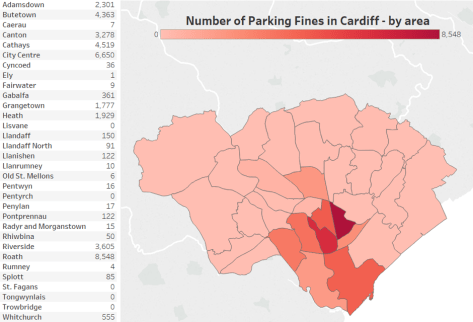
Roath is the most popular region within Cardiff for offences, with 8,548 in the period studied in 2017. Unsurprisingly, the city centre is also a popular area for tickets, with naughty parkers racking up 6,650 there. Cathays, Cathays Park and Butetown all took a 4,000 ticket hammering, while at the other end of the scale Ely, Morganstown and Thornhill all received just a single parking ticket to date.

Eagle eyes on Museum Avenue

Visitors need to be extra careful when parking on Museum Avenue, as eagle eyed parking inspectors gave out nearly 1,000 tickets on this street alone in 2017. King Edward VII Avenue – the road that runs parallel to Museum Avenue and crosses Alexandra Gardens – is second on the list. Heath Park main car park, Churchill Way and Tredegar Street then complete the top five.

Top 25 most popular Cardiff streets for parking tickets:

  1. Museum Avenue – 945
  2. King Edward VII Avenue – 905
  3. Heath Park Main Car Park – 825
  4. Churchill Way – 787
  5. Tredegar Street – 631
  6. Havannah Street Car Park – 587
  7. Windsor Place – 579
  8. Albany Road – 553
  9. Fitzhamon Embankment – 546
  10. Canal Parade – 512
  11. Gorsedd Gardens Road – 491
  12. Bute Crescent – 488
  13. Bute Street – 478
  14. Plantagenet Street – 467
  15. St Andrew’s Crescent – 464
  16. West Bute Street – 458
  17. Severn Road Car Park – 454
  18. Mount Stuart Square – 431
  19. City Road – 419
  20. Park Street – 412
  21. Cathedral Road – 369
  22. Diana Street – 364
  23. Park Place – 363
  24. Dumballs Road – 362
  25. Womanby Street – 353

If you were looking for a day to risk not buying a ticket, I’d suggest you don’t pick a day in the middle of the week: Tuesday, Wednesday and Thursday are the most common days for motorists picking up parking tickets. The spread across the year also shows fewer tickets are  distributed during the summer. Perhaps it’s because the nice weather encourages people to walk, rather than drive? Or maybe the parking inspectors are forced to walk more in the winter months in an effort to keep warm?

Considering that a parking ticket carries a minimum £35 fine, this is a huge source of income for the council. Even considering that some of these may have been tests, duplicates, or won’t be immediately paid, it still runs into at least a million pounds of revenue.

The following has been paid in parking ticket fines in Cardiff over the last three financial years:

  • 2014/15: £1,896,336
  • 2015/16: £1,917,687
  • 2016/17: £1,272,772

Although 50,000 tickets might have been handed out, it’s unlikely they’ll all be paid. Between April 1 2016 and March 31 2017, just over 20 per cent of all parking tickets were appealed – 12,348 out of 60,622. A high number of these appeals were successful (67 per cent), so  recipients were not ordered to pay.

It seems unusual that such a high number were successfully appealed. The council only gives two reasons for the successful appeals: “general” and “CEO error”. It’s unclear what the first category refers to, but the latter means that the civil enforcement officer made a mistake in giving out the ticket in the first place. So if you think you have been wrongfully given a parking offence, it can be worth appealing the fine.

***

Swaps: Photographs from the David Hurn Collection

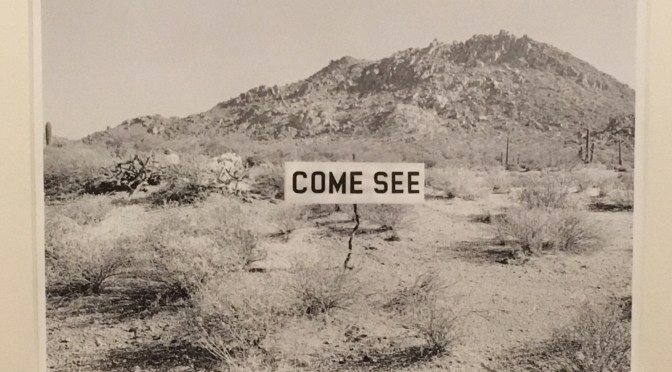
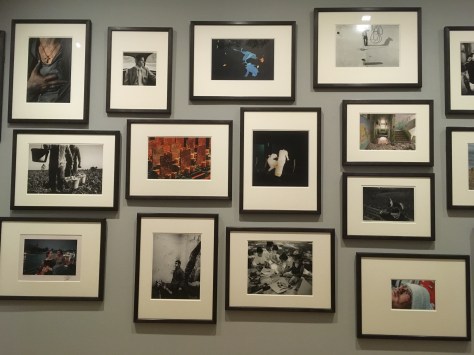
It is easy to forget that photography, at its core, is a shared experience. Swaps, an exhibition that cultivates photographs from David Hurn’s private collection, is a reminder of the process by which twentieth-century photography developed: through sharing photographs. This exhibition, now being held at the National Museum in Cardiff, has been curated through years of David Hurn playing swapsies with a variety of photographers. The result is a collage of photographs that are simultaneously intimate and universal. The work spans roughly 60 years, ranging from politically-motivated pieces to more surrealist, modern photographs. Generally, the exhibition feels professional in its rigour and variety, but also so warmly familiar when the context of the exhibition is appreciated.

The exhibition has a feeling of familiarity to it, like someone showing you a dusty old photo album, but this familiarity is offset by the sheer quality of photographic skill on show.  The collection comprises of photographs by leading 20th and 21st century photographers such as Henri Cartier-Bresson, Eve Arnold, Sergio Larrain, Bill Brandt, Martine Franck, Bruce Davidson and Martin Parr, but there are also some more unique, less famous photographers, such as ieke Depoorter, Clementine Schneidermann, and Newsha Tavakolian.. This certainly isn’t a safe exhibition, yet that means it doesn’t suffer from contrivance – it flows naturally from photo to photo, from generation to generation, with Hurn’s passion and interest for each photo being apparent thoroughout. It’s kind of like having somebody else’s time capsule you can dip into for a little bit, except that other person happens to be a gifted photographer with really cool mates.

EA4A85C5-5F52-42C2-AC5D-2FF694D200B7

A particular highlight from the exhibition includes a photograph of Henri Matisse by Hurn’s close friend Henri Cartier-Bresson, as seen on the bottom here:

8AEA76A9-6894-4635-801F-D3F53BA2B6FE (1)

It is a reminder that Hurn, despite his modesty, is up there with the pantheons of the art world, yet you would never think it reading over his genuine and friendly descriptions of his photographs. The exhibition details the context and story behind each photograph from Hurn himself and, sometimes, these descriptions are as entertaining and thought-provoking as the photographs themselves. There’s a video installation, too, where you can hear Hurn speak about some photographs in his own voice. Overall, the exhibition is organised to give off a very homely and understated feel, yet maintain the impact of some of the photographs. There is no pretension here, just an immensely talented photographer talking about and showing images from a craft he has been embedded in for years.

The exhibition is in place until March 11th, so pop down before it finishes! There’s an event where you can see David Hurn speak with his friend and fellow photographer, Martin Parr, about the photographs and life as a photographer in general on 7 February, too. Tickets are £10 and links to the event and the Welsh museum page can be found below.

Swaps

A Conversation with Martin Parr & David Hurn

E7EF3BB7-68A2-4F9E-BAE4-2A8145026548

***

Over 1000 properties lay empty in Cardiff

Data journalist Dan Clark continues his series of investigations for us: today, he looks into the number of empty properties in the capital.

A total of 1,318 private sector properties in Cardiff laid vacant in the last financial year (2015/16), according to new figures released by the council. Currently in the city, almost one in every 50 properties is vacant. Across the whole of Wales, there are 23,000 private properties that lie empty, a figure which has risen from 19,612 in 2012-13.

The Cardiff data, published in response to a freedom of information request, shows that 166 homes have been empty for over 5 years and 39 for over 10 years. Grangetown was the parish with the highest volume of vacant properties, recording 233, although it wasn’t clear from the response why it was so high here.

Furthermore, as of June 2016, there are 205 empty council properties. The most popular categorisation of these are ‘routine voids’ (77 per cent), followed by ‘low demand’ (5 per cent). Properties classified as ‘routine voids’ refers to empty homes that require minor repairs and safety checks.

Apologies for the stats overload, but your basic take away from this is that Cardiff has a lot of empty properties. My first thought was that perhaps the demand just wasn’t there for them, but that couldn’t be further from the truth. As of 1 January 2017, there were 7,893 applicants on the Council’s housing waiting list.

So, what is being done? Cardiff Council have a scheme called the ‘Housing Enforcement Empty Property Policy‘, designed to help tackle the issue. Two of their main objectives are:

  • To bring back into use as many empty properties as possible
  • To limit the effect of empty properties on the Community, Council and Owner

According to figures published in the policy, the Council are currently returning an average of 62 vacant properties a year back into use. Some of the reasons cited as to why they become vacant in the first place include, dilapidation, abandonment, unresolved ownership, property holding and care holding.

Earlier this year, plans were passed for a new £2bn “garden village” on the outskirts of the city. As part of this, almost 6,000 new homes would be built. Of that number (5,970 homes), 30 per cent would be affordable housing – half of that being social rented homes and half low cost homes. But that’s still only around 1,800 homes in total, with no further details that might help people on that housing waiting list.

Having investigated the number of empty homes that already exist within the city, building so many new ones seems like an unnecessary cost. Would it not be more beneficial to spend more resource on the empty properties policy first and increase the number being brought back into use each year?

Michelle Collins manages the Empty Homes Wales project by United Welsh, a not-for-profit social landlord with over 25 years of experience in housing and development.

She said: “Seeing homes that are left empty to go into disrepair stirs up many emotions and feelings, especially at a time when Wales has a housing crisis, with 12,000 new homes needed each year to meet current demand.

“Transforming empty homes into habitable spaces is an innovative way to provide much-needed homes and help homeowners to protect their assets.”

Refurbishing a property may seem daunting, but help is available. The Empty Homes Wales project uses an innovative leasing model that doesn’t require any financial outlay from the homeowner.

Empty Homes Wales leases properties to recoup the cost of the refurbishment, then it’s up to the homeowner – United Welsh can carry on leasing the house on your behalf, you can rent it yourself, or sell up. The rental income received during the term of the lease is used to cover the cost of the refurbishment work.

Michelle added: “We work in partnership with homeowners to overcome any barriers they may face, such as inexperience of leasing property or lack of information around refurbishment standards or contractors.”

More information on housing in Cardiff:

***


Catch this family friendly Cardiff Christmas show, made by feminist theatre pioneers: The Giant Who Had No Heart In His Body

If you’re looking for some heartwarming, family friendly theatre to warm your cockles before the big C hits this year, head to Chapter on Friday 22 and Saturday 23 December! Likely Story Theatre’s newest work – The Giant Who Had No Heart In His Body – includes grand tales of adventure, once forgotten fables, and that anecdote your uncle always tells at Christmas. No matter what they are about, stories can’t just be told – they have to be caught. Thankfully story catchers Agi and Dot are doing just that. Watching from their home in the clouds, they scout the sky for stories and catch them before they float away on the wind. Now the pair face something they’ve never faced before: telling their own story. Will they be able to pull it off? Only time will tell…

This is a lovely Christmas show that takes on an Norwegian fairytale using a magical mix of puppetry, live music and humour. GET YOUR KIDS THERE (grown up ones too!), THEY WILL LOVE IT.

WHEN AND WHERE
Friday 22nd December, 6pm (British Sign Language interpreted performance) &
Sat 23rd December, 11.30am and 3.30pm.
Chapter Arts Centre, Market Rd, Cardiff, CF5 1QE Tickets: £5 / £17 family ticket (4 tickets including at least 1 child)
Info: www.likelystory.org.uk
Tickets: www.chapter.org


This heart-warming show was created by Likely Story’s founders Hazel Anderson and Ellen Groves, with the help of their young children.

“We were developing a piece with my son Toby in the room,” Hazel explains, “we were playing with ideas and getting really excited when Toby started to cry because we’d left him, our audience, behind. We did the piece again but, this time, we built up the energy more slowly and bought him with us. It meant we created a scene with a completely different feel.

“It was a good reminder that the audience wants you to play with them, not just for them.”

Motherhood hasn’t just had an effect on this particular show, however, as Likely Story acts as a flagship company that demonstrates how creative organisations can foster the talent of mothers, and how people can create theatre as a family.

“In a professional setting you so often feel like you need to apologise for your kids being in the room,” says Ellen “now we’ve changed that from being seen as a burden, to being a gift.”

With both kids and grown-ups helping to shape The Giant Who Had No Heart In His Body – and with tickets only £5pp or £17 for a family of four – the entire family can see a show that is just as funny and fascinating for the over 70s as the under 7s.

“In the mix of a very commercialized Christmas, this is a show that aims to bring families closer together with play, love and lightness. It’s a show that is created with a lot of everyday objects, so that families can play and recreate it at home” says Ellen.

Hazel explains: “It’s a show that kids will laugh at, adults will laugh at, and they will both laugh at each other laughing.”

Likely Story Theatre was founded in 2006 by likely ladies Hazel Anderson and Ellen Groves. It was created on the simple philosophy that the women shared: the belief that storytelling is magical and that stories are best brought to life through the imaginative use of ourselves and everyday objects.

***

The number of homeless people in Cardiff is on the rise

This is data journalism student Dan Clark’s first in a series of investigative pieces for We Are Cardiff: looking into the number of homeless people in Cardiff.

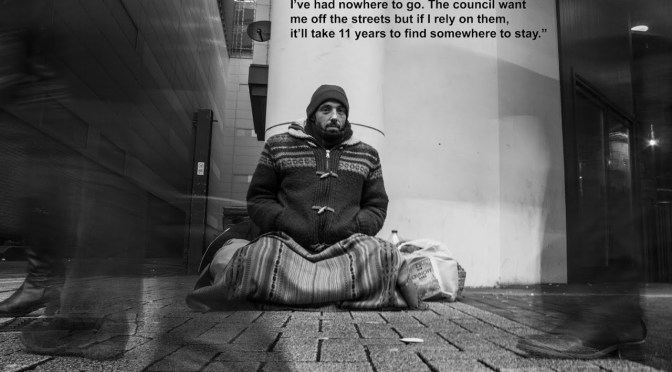
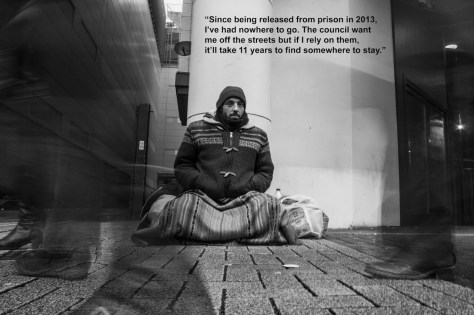
Photo by Ben Blyth Photography, from his Behind the Streets project

The number of people sleeping rough in Cardiff has increased by 18 per cent from this time last year, according to statistics released by The Wallich homeless charity.

Monitoring of rough sleepers was undertaken by Rough Sleepers Intervention Teams (RSITs) working for the charity.

For those of us who live in Cardiff, the problems surrounding homelessness are obvious. It is almost impossible to walk through the city centre and go more than five minutes before spotting a rough sleeper. From a personal point of view, since moving to the city in 2016, the noticeable increase has been undeniable.

As you can see, the number of rough sleepers being supported is increasing, which has consequences. A Freedom of Information Act request to Cardiff council revealed that between 1 January 2015 – 15 May 2017, a total of 19 homeless people died on Cardiff’s streets.

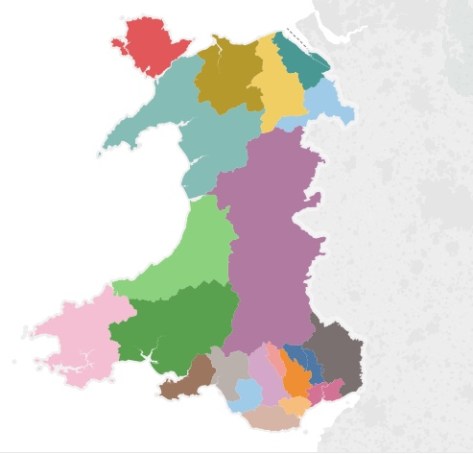
Cardiff’s problems appear at the national level, with the number of rough sleepers having increased in almost all local authorities over a 12-month period. The data, collected by RSITs and released by the Welsh Government, gives a one night snapshot of those sleeping rough across Wales. The below map shows the year-on-year comparison in individual local authorities: click on it to explore the statistics.

I spoke to George, 32, who is a former factory worker and has been homeless for just over 2 years. “I lost my job and just couldn’t afford the rent. In the end, I had no one else to turn to so ended up on the streets”.

Asked whether he believed that the number of rough sleepers had increased, he answered: “It certainly does seem that way”. George went onto clarify that he couldn’t say for certain if it had in Cardiff specifically, as he often drifted from city to city, and had not been in Cardiff long.

George added that the kindness of charities and the public is always appreciated, however small those gestures may be: “It might not seem like much to normal people, but something as simple as a warm meal or a thick duvet is seen as a luxury to us lot. Something small can help improve your mood and make the day seem a bit brighter”.

On 27 October, the Wallich was lucky enough to partner with mattress retailer Leesa Sleep, who donated 40 brand-new mattresses to two of its Cardiff hostels. International Welsh rugby player George North and World Champion Cyclist Becky James who are ambassadors for the charity also attended the event.

Mike Walmsley is Corporate Fundraising Manager for The Wallich. “We are so grateful to Leesa for this incredible donation and to Becky and George for taking the time to visit our hostel and speak to our residents,” he says. “A lot of our people will have had to ‘make-do’ for a long time with second hand clothes, charity shop furniture and food bank vouchers. Some rough sleepers may not have slept in a bed for months. Having something brand-new that gives someone a good night’s sleep shows a person that they are valued and that they deserve nice things. This has a positive impact in helping someone back on their feet after experiencing homelessness.”

If you’d like to do something to help homeless people in Cardiff this Christmas, we wrote this handy guide:

Dan Clark is currently studying for a Masters in Computational and Data Journalism at Cardiff University. He moved to the city in 2016 and since then has fallen in love with the place. Thanks Dan!

***


Roath Farmers Market

If you’re after fresh produce in Roath, the Farmers Market is the place to head to. Great prices, local producers – each week you’ll find up to 30 producers selling the best in fresh, local Welsh and organic food. Photojournalist Veronika Merkova went along to snap some of the treats on offer.

If you’re hungry, you’ll also find delicious home-made ‘world’ foods representing the diversity of Cardiff, from bread and cakes, fish and meat, flowers and fruit and veg, to farmhouse cheese and Welsh organic whisky – the first certified organic whisky in the world.

Roath Market

Every Saturday 9.30am – 1pm
Mackintosh Sports Club, Keppoch Street

CF24 3JW (opposite Gate Arts Centre)

Veronika says: “Visiting the farmers markets around Cardiff was a great experience as I found it an alternative that is needed. We have big chains and supermarket sourcing our food and we usually don’t know where they come from as well as the quality isn’t the best that we can get. I was very excited to see the range of vegetables and fruits that the farmers provide. The actual quality was amazing too and the taste was nothing like shopping from a super market. It is also a very nice feeling of supporting the local community. Both Roath market, even tho a little bit smaller, and Riverside market were full of stalls and lovely people that would be happy to tell you all about their product.”

See the full photoshoot at our Facebook page: We Are Cardiff – Roath Market photo gallery

More info: Roath Market

***


Cardiff’s birds: autumn migrations

Rowan Dent writes for us about autumn migrations and the birds in Cardiff.

Pied wagtail

Autumn in Cardiff sees the city filled with birds returning from a feast of butterflies and berries in northern Europe and Asia. Like me, they are strangers to the city but seem to know where to make their home.

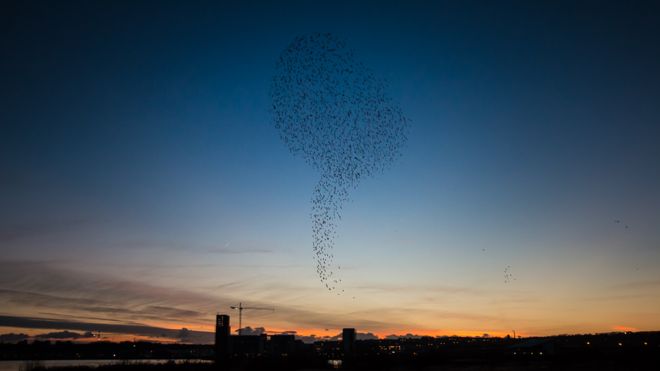
Come winter, even the centre of Cardiff becomes host to little pockets of wildlife. Pied wagtails roost in the clogged gutters and chrome-plated arms of Cardiff city centre’s newest buildings on the Hayes. Dark-eyed Canada geese can be found in Roath Lake. Take a stroll through the red-gold trees of Bute Park to Blackweir and you might be lucky enough to spot a few lusty sea salmon leaping upstream as starlings create magic eye patterns with their sculptural murmurations.

https://www.instagram.com/p/Bab1TSsDXtx/?taken-at=798401977

If you venture a little further afield the rewards can be surprising. At Lavernock Point 8km south of Cardiff, you can spot rare migratory birds like fieldfares and redwings across the Bristol Channel (not far from where the Welsh government is threatening to dump 300,000 tonnes of radioactive mud dredged from Hinkley Point).

Curlews, redshanks, dunlins and oystercatchers feed on Newport Wetlands, using their elegant pointy beaks to sift through the mud for worms and grubs. I’ve never heard them but twitchers claim that at Cosmeston Lakes just outside Penarth you can hear the eerie booming of bitterns at dusk.

This extraordinary hejira is an ancient phenomenon. 3,000 years ago, Homer and Aristotle noted that birds fly across the seas every winter and the ancient world was filled with fanciful ideas about where they went. Aristotle and his students believed that swallows hibernated, for example. Or that the birds that arrived for the winter were the very same birds they had seen all summer long, just wearing a muted winter wardrobe.

The magnificently entitled 1703 pamphlet “An Essay toward the Probable Solution of this Question: Whence come the Stork and the Turtledove, the Crane, and the Swallow, when they Know and Observe the Appointed Time of their Coming” claimed that when birds disappeared in autumn, they went very far away. About 384,400 km away in fact. To the moon.

Since then, ornithologists have used tracking devices to uncover the web-like paths of migration across the world. Navigating by the stars, magnetic fields and polarized light patterns invisible to humans, migratory birds follow a complex internal map which enables them to cross oceans and continents without getting lost.

When the time comes to migrate, many birds enter a stage of hyperphagia, where hormones compel them to store extra fat to use as energy while travelling. Some bird species double their body weight in the weeks leading up to migration. Even caged migratory birds will start to anxiously look in the direction of their eventual destination. It might be the lengthening of days or the cooling air, but somehow they know it’s time to leave. There’s even a word for this in German: Zugunruhe, literally ‘journey disquiet’.

Murmuration of starlings over Cardiff bay wetlands reserve at sunset / Nick Dallimore

And as they take to the skies, flocks create elaborate strategies to protect each other from predation and exhaustion, keeping the youngest birds safe in the middle as the older ones take turns at the front where the going is toughest. Curiously, migratory birds actually have smaller brains than resident species, proving once and for all that bigger isn’t always better. As well as using magnetic fields and natural landmarks, they can even smell when its time to land. Migratory birds know no borders. Home is where there is food, space, sanctuary.

As I settle into my new nest in a city which is both foreign and familiar to me, I am comforted by the chatter of our northern visitors. It seems to me like a glorious gift – even as the days grow dark and bitter cold our skies and seas are filled with fireworks of feathers and song.

Rowan Dent is a freelance copywriter and poet who likes pigs, Oxford commas, and origin myths. She lives in Canton with her partner and a garden of baby vegetables.

***

The history of Clarence Bridge and William Harpur

My latest post for Caught By The River was published recently, for my Wandering the River Taff column. In it, I explored the history of Clarence Bridge, which connects the wards of Butetown and Grangetown. I always end up doing about ten thousand percent more research than I can fit in the columns, so get ready for all the interesting extra bits I couldn’t cram in.

The basic history of the bridge is documented in the piece:

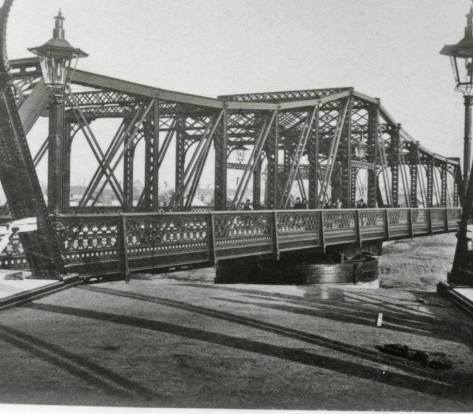
A wooden swing bridge went over the Taff, about a hundred or so metres south of where the bridge is today, joining ‘Lower Grangetown’ to the Docks. This bridge connected the areas from 1861 to 1890 – the period when the docks started booming. Increasing numbers of people started using the bridge to get to work from Grangetown, but the Taff Vale Railway Co leased the bridge privately, and started charging for its use.

(Map: Glamorgan XLVII, surveyed: 1878 to 1879. Published: 1885)

Towards the top right of the picture, you’ll see James Street running horizontally across (it’s where you’ll find the police station today). If you stretch that line out directly to the left, you’ll find the current location of Clarence Bridge.

I did quote from the wonderful Grangetown Cardiff’s history section in my column, but I didn’t manage to get all the details in. On the day they introduced the toll, local residents rioted and threw the bridge’s gate off its hinges and threw it in the river.

The Times reported that 1,000 men took part in the protests each day against the railway company. There had been “upmost good humour” for the most part, as 200 police stood by, but then there was direct action. “They rushed at the newly-erected toll gate and tore it from its hinges, throwing the structure in the river.” The first gate was replaced the following day, as well as a sentry box for the toll-keeper. The toll house was also damaged. The paper later publishes court reports of three men who were arrested for causing the damage, costing £5 – Cornelius Dacey, William Smith and William Webb, all under 23. Police were also after another man called William Drew, who was heard to shout “Go it boys, that’s right, pull it off!” The court was told of “200 armed navvies with iron bars up their sleeves.” The three were found guilty and the judge expressed sorrow at having to sentence them to a month’s hard labour.

Eventually the Cardiff Corporation relented to the chaos and built two proper public access bridges – Clarence Bridge, which spanned the River Taff, and the James Street Bridge, which spanned the Glamorganshire Canal. You can see both these bridges appearing in maps from 1898 onwards. Also note the original wooden swing bridge has disappeared – been dismantled by this point, leaving Hamadryad Road cut off abruptly by the Taff.

(Map:Sheet 263 – Cardiff (Outline) Published: 1898)

If you want to see the location of the original wooden bridge, head to Hamadryad Road on the Butetown side. You can’t reach the Taff directly as there’s a big fence up, but if you face the water, you’ll be standing roughly where that original bridge was – well over 100 years ago. It had cost £60,000 when it was originally built.

Grace’s Guide shows the original plans for the bridge, which was designed by William Harpur. I’d never heard of him before, but turns out he’s a fairly important figure in Cardiff’s modern history.

Some more lovely photos that were posted in the Cardiff – Now and Then Facebook Group by David Lawson:

Clarence Bridge construction, 1898


The original Clarence Bridge, mid swing

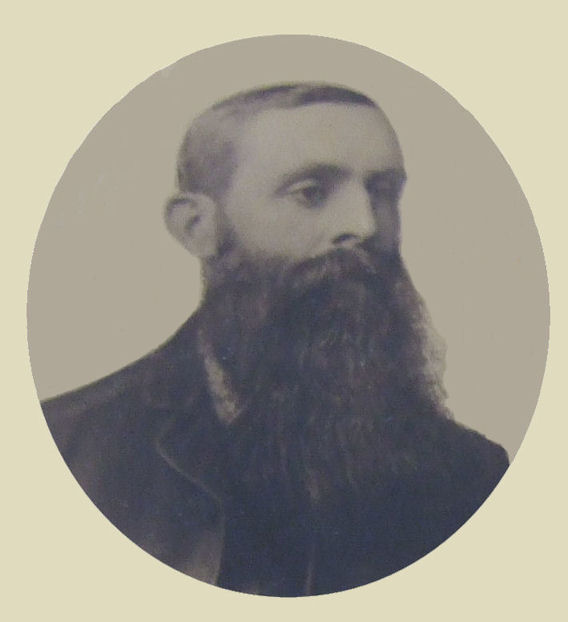
William Harpur, the bridge’s engineer, is not really a household name, but modern Cardiff has his fingerprints all over it. He was appointed Borough Surveyor in 1883, and as such had final and ultimate say over all proposed street layouts and individual buildings that were going up through the city’s boom years.

If you’ve walked down Castle Street, visited Cardiff Indoor Market, or been to Roath or Victoria Parks, you’ll have first hand experience of his work. There’s also the civic centre at Cathays Park, the widening of the Hayes and Working Street. He built the city’s first municipal hospital (the Hospital for Infectious Diseases – later Landsdowne Hospital) and also the Pumping Station – now an antiques market.

Harpur was also engineer to the tramways department, and carried out the construction of the track for the electric cars. As his obituary so delicately puts it, his mark is left on the lay-out of every inch of modern Cardiff: all the plans of new roads, buildings, bridges etc having had to receive his approval.

William Harpur – 1853-1917, Cardiff city engineer and surveyor

Bit of a hero, William Harpur. Good beard too.

Read all of my entries about the Taff in my Caught By The River column

***

How to help Cardiff’s homeless people: Christmas 2017 edition

Over the past couple of years, the incredible Project Shoebox has gathered hundreds of boxes from you generous people to gift during the cold winter months. This year Project Shoebox isn’t running again, HOWEVER, some charities that support homeless and vulnerable people are running their own collections. So you can still donate and support. Also big thanks to Mali who has tirelessly pushed Project Shoebox in the city. Much respect.

There’s plenty to show the number of homeless people in Cardiff and across the UK is increasing. The Wallich publish figures of the number of people they support on a monthly basis, and while this isn’t an absolute figure, you can see the rough trend.

You can find out more and donate money to the Wallich here: https://thewallich.com/donate/

If you would like to donate money to Women’s Aid, you can do so here: https://www.justgiving.com/cardiffwomensaid

You can also donate directly to The Huggard Centre: http://www.huggard.org.uk/how-you-can-help/donate/

Llamau are collecting gifts and care packages. Gifts can be dropped off at the Llamau office Mon-Thur 9-5 and Fri 9-4.30, with a cut-off date around the 11th December.

Llamau head office address: 23 Cathedral Road, Cardiff, CF11 9HA (029 2023 9585)

Here’s what’s on Llamau’s Christmas wish list: feel free to buy other things, if you think they would be suitable. Llamau support men aged 16-24, women of all ages, and children up to age 16.

  • Sweets/chocolates/biscuits
  • Watercolour painting set
  • Adult colouring books
  • Stationery/pens/pencils/folders/colouring pencils
  • Calendars/diaries
  • Cook books
  • Hairdryer/brushes/hair accessories
  • Men’s toiletries
  • Perfume/aftershave
  • Women’s Toiletries/bath fizzers
  • Make up/nail varnish
  • Socks/beanies/scarves/gloves/umbrellas
  • Pyjamas/slippers
  • Headphones
  • Purses/wallets/backpacks
  • Hot water bottle
  • Soft furnishings/cushions/photo frames
  • Small alarm clock
  • Cookware
  • Children’s toys/ books/pyjamas/games/puzzle books

Maybe get some inspiration from this homeless care package:

If you have any other details of ways people can support homeless and vulnerable people this Christmas, please leave a comment below and share this article.

Peas

WACx

***

The man who ate Cardiff

Lee Eynon of Füüdblog tells us how he ate Cardiff.

It all started as a terrible mistake.

The novelty of Man Vs Food hadn’t worn off yet, and me and Pete thought we could handle the (now defunct) North Star pub’s giant burger challenge.

It was a very, very big burger. The size of a dozen quarter pounders.

After half an hour of glumly shovelling room temperature grey mince into our mouths we finally realised how wrong we were. While our respective other halves tried not to dwell too much on the terrible relationship choices that had led them there, I came to a realisation; food can be funny.

That’s how Füüdblog was born. I wrote about the experience of debasing myself with that sofa-cushion-sized behemoth of a burger to get a laugh – and it worked.

Cut to four years later and it’s been a bit of a ride. I’ve found myself invited to restaurant openings, quoted on WalesOnline, judging a sandwich competition, becoming embroiled in the odd Twitter barney and even helping brew a beer.

I’ve also experienced a new side to the city I call home, and I’m grateful for that.

People can be a bit down on the Cardiff food scene. It’s true that we’ll never be a London – we won’t even be a Bristol for a few years yet; there are too many boring chains in the city centre, we don’t have a Michelin Star standard restaurant and yes, we’re all a bit tired of new burger places.

But our food scene does have passion, guts and an incredible collaborative spirit.

Maybe it’s born of being such a small city, but everywhere I look I see small Cardiff food and drink businesses working together, pooling their skills and knowledge and trying out new things, whether they’re breweries, bakeries, butchers or bars.

Meeting the people who make up this amazing, ballsy, giving community is by far the most rewarding thing about food blogging in Cardiff.

Our local food and drink industry is full of people literally living their dreams – people who have had the courage to quit a relatively safe, comfortable 9-5 lifestyle to pursue something they love.

Not that I’m trying to romanticise it – speak to anyone in the business and they’ll tell you it’s a daily battle. From exorbitant business rates to no-shows and fake TripAdvisor reviews, there’s no shortage of obstacles to making a living feeding and watering others.

But you know what? Speak to Phil from Dusty Knuckle, Rhys and Adam from Crafty Devil, Shauna and Sam from Hangfire or a dozen others and I guarantee that they’ll tell you it’s been worth the blood, sweat, tears, burns and heartache.

And that’s why I think it’s worth writing about what they do.

My Top 5 Cardiff Eats

Picking my five favourite things to eat in Cardiff is like trying to pick my five favourite songs – basically impossible. But if I absolutely HAD to choose, then in no particular order:

  1. Blas-Y-Mor, Dusty Knuckle, Canton

Its name may mean ‘taste of the sea’ but it’s just as much a taste of Wales – the Dusty Knuckle team are obsessive about using the best quality Welsh produce on their wood fired  Neapolitan-style pizzas. This cockle, bacon and samphire crowned masterpiece will have you on your feet blasting out the anthem after a couple of bites.

  1. Steak and Chips, Asador 44, City Centre


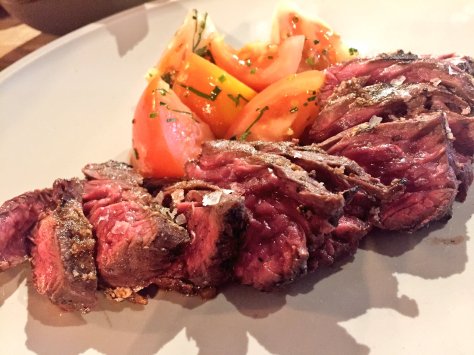
You can get steak and chips in Wetherspoons for about a tenner. You can also do this at Asador 44 with their lunch menu. One will be a tasteless slice of shoe leather. The other will be a thick, juicy slice of heaven on a plate that you’ll want to eat in silence with your eyes closed. You can probably guess which is which.

  1. Pit Boss Plate, Hangfire BBQ, Barry

Remember when you were a kid and you wanted to have all the variety pack cereals at once but you weren’t allowed? Well imagine finally being able to do that, only with meat. The PBP is a taste of everything that has quite rightly made Hangfire Southern Kitchen famous – barbecue, cooked low and slow the way it’s meant to be. Their restaurant may be in Barry, but the Hangfire ladies cut their teeth in The ‘Diff and they pop-up here enough that I reckon we can still call them our own.

  1. Chocolate Brownie, Pettigrew Bakeries, Victoria Park

“A chocolate brownie can’t be that good can it?!” – try saying that after eating one from Pettigrew’s. You won’t be able to. Partly because your mouth will be stuck together with the gooiest, richest, most magnificently chocolatey lump of loveliness you’ve ever tasted, but also because you’ll realise just how wrong you were.

  1. Chicken Curry (Off the Bone) and Chips, Dorothy’s, Caroline Street


(photo from TripAdvisor)

Better than any kebab and surprisingly palatable while sober, this is a true Cardiff staple. You have never truly tasted life in the Welsh capital until you’ve sunk one too many pints of Brains on match day, meandered your way up to Caroline Street and devoured a polystyrene cartonful of this glorious stodge.

Follow Füüdblog! @FüüdblogFüüdblog website

Big thanks to Lee for this great round up of his best Cardiff eats! Now who fancies a trip down Chippy Lane??

***

Twelve Cardiff Instagrammers you have to follow …

Ten Cardiff Instagrammers you have to follow …

In case you’re of this persuasion, yeah, we be grammin. Follow us @WeAreCardiff.

@ShotByGoldcut

26 year old Abdullah Yahia has to be one of the most inspiring fashion photographers working in the city, destined for big things. Follow him for ethereal landscapes and his forthcoming film work …

“The world breaks everyone and afterward, some are strong at the broken places.”

abdullahyahia.uk

https://www.instagram.com/p/BZcNBekDN9w/?taken-by=shotbygoldcut


@harplington

Okay, she’s not strictly based in Cardiff, but she comes here to shoot a lot and her wildlife photography is just wonderful! Big shouts!


@xeno.v

For unexpected angles of this wonderful city of ours, get on 18 year old xeno.v (aka Qureshi)’s feed. He posted one of our most viewed IG photos of last year – the beautiful shot of the ‘Cardiff eye’ from Winter Wonderland last year.


@ilovesthediff

For ongoing documentary of what’s happening in the city, follow Chris’s feed. Also does a tidy line in tees and other merch. ilovesthediff.com 


@butepark

The official feed for the Bute Park Arboretum – Cardiff’s premier park with a nationally-significant tree collection! Follow them for adorable hedgehog photos and the life and times of our wonderful park. bute-park.com

https://www.instagram.com/p/BVzW7jsFfPk/?taken-by=butepark

@thecardiffcwtch

If you wanna see endless delicious posts of life around Cardiff mixed in with fashion, food and a mischievous Golden Retriever pup called Bungle, the Cardiff Cwtch is your gal! thecardiffcwtch.com

@avantgardevegan

While we’re talking about food, there’s one Cardiff blogger you have to follow, and despite what his name might suggest, this is food that even omnivores will be desperate to devour. Don’t believe me?? Just head over to 25 year old Gaz Oakley’s feed and see for yourself… avantgardevegan.com  /  YouTube for Recipe Videos


@igerscardiff

It’s a bit of a no brainer to say you should be following @igerscardiff … collaborating Instagrammers who meet in Cardiff. Photowalks, Socials and Competitions and part of the Igers Network! igerscardiff@gmail.com

https://www.instagram.com/p/BYvgO8wBxRs/?taken-by=igerscardiff

https://www.instagram.com/p/BV1b8GfBZ0m/?taken-by=igerscardiff


@sianrockingtheshots

Beautiful shots from around the city – filtered!


@photoj_lorna

Lorna Cabble is one of our fav USW-graduated photojournalists! Follow her feed for news of projects around south Wales. m.facebook.com/LornaCabblePhotography


@senedd

It’s pretty cool that our National Assembly has its own Instagram feed … follow for events around the building and the bay, and to follow the law-making and government-scrutinising process in action! assembly.wales


BONUS!

@ZeldaPooch

We couldn’t finish without including our very own rescue dog, Zelda. We rescued her from Cardiff Dogs Home last week, and she’s quickly becoming an Instagram star! I mean, we would say this, but we think she’s adorable. If pets on IG is your vibe, follow her! (More about how we got Zelda here: Meet Zelda)

***