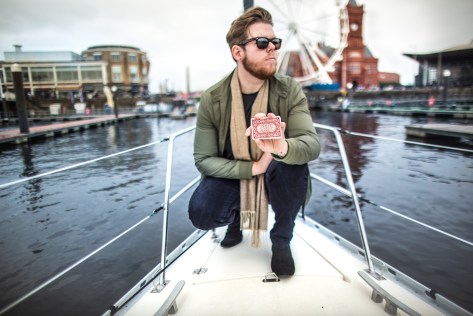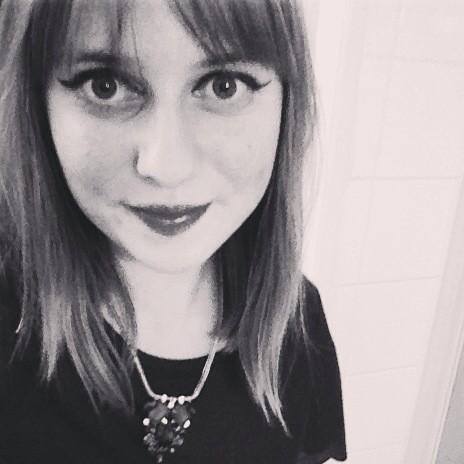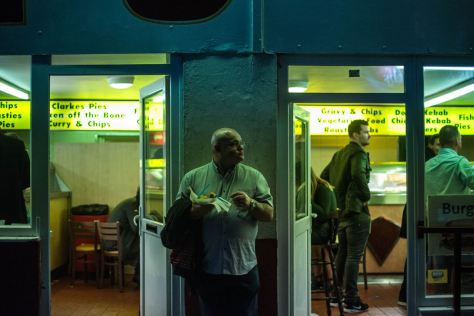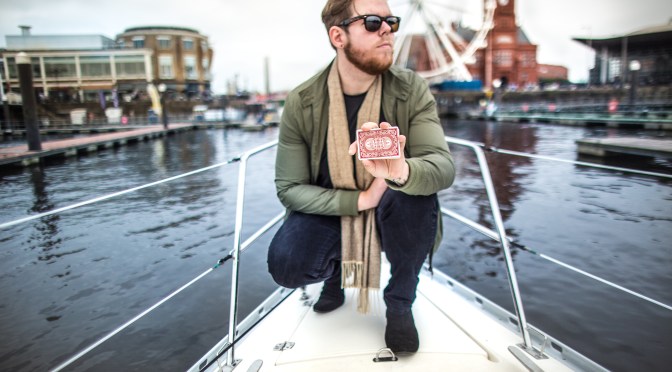
Photojournalist Lorna Cabble spent three months hanging out with her camera, after hours – photographing the city’s late night scene. Over to Lorna to explain more about her project.
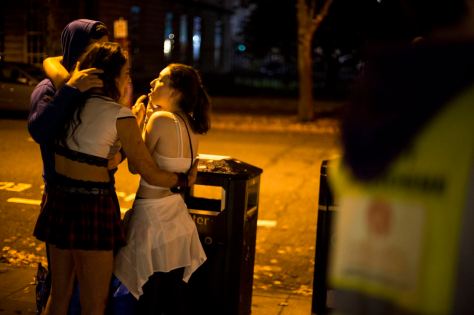
UNITED KINGDOM, WALES; Autumn/winter 2016. Image shot while working with Cardiff Street Pastors, a voluntary based organisation that aim to protect people while they’re on a night out in Cardiff on a Friday and Saturday night.
During my second year as a student in Cardiff, there was a lot of publicity on the attacks that had happened to female students around the Cathays area, and I couldn’t stop thinking about it – the subject struck a chord with me. It was really in our faces, so I just kept thinking “I really need to do a project on this, or it’s going to bother me.”
I didn’t know where to start, so I started photographing students being students on the streets of Cardiff (students are so great) and ended up seeing a poster for the “Student Safety Walk”, an organisation that gets students (both male and female) home safe, or looked after when they’re in a bit of a mess – so I contacted them to see if they’d mind me tagging along.
For this project I was probably out in town at night at least three times a week. The Student Safety Walk went out twice a week, so I made it out with them as often as I could around work. I was also out on just general shoots, and with Cardiff Street Pastors a few times too.
The things I saw were a bit shocking, but in an amusing way more than anything. All I kept thinking was “how are theses people not cold in their outfits?”, while I was wrapped up in a coat and scarf and freezing!
There was a guy who had a whole bottle of scotch to himself, he was just completely unable to do anything, and threw up every five minutes, we had to get him an ambulance – it was a bit scary. His housemates came out of the student union a while later and saw him while we were waiting for the ambulance, so we filled them in on what was happening – but they left him. That was really shocking for me, and kind of made me realise why I was documenting the kind people looking after him and others in similar positions to begin with.
I did see a few worrying scenes where there would be a guy trying to take a girl home – but she would have no idea who he was – so it was good to see that being stopped. And I also saw taxis reject a lot of lone females, or groups of females (as well as males) as their journey home wasn’t long enough for them – or sometimes they were too drunk (which I kind of understand, but it’s worrying that they’d then have to walk home). I also saw some really lovely scenes where people were just kind to each other, so it balanced out.
My next project kind of spring boards from this one: I’m photographing people who have been sexually assaulted and I’m getting their stories. I’m going for straight-forward portraiture with this one, and it’s basically aiming to encourage people to speak out about it and try and get rid of some of that stigma – like feeling like you’re to blame, or feeling like you can’t talk about it from fear.
Anyone is welcome to participate in this project, any gender, and an assault of any scale – it’s all important to me. For me personally, photojournalism is just being able to provide those who want/need it with a voice.
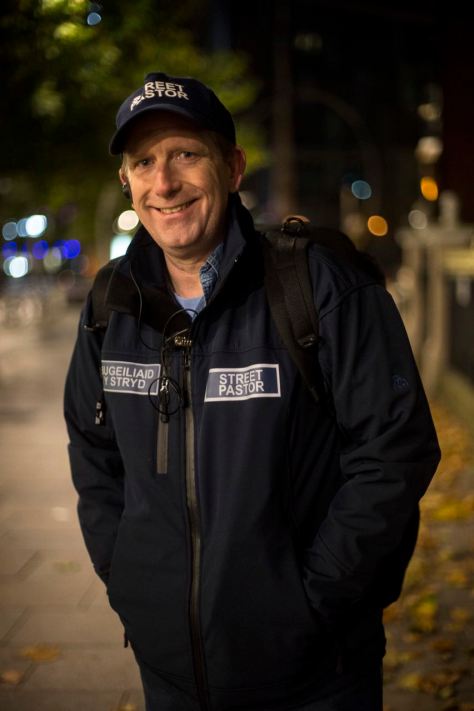
UNITED KINGDOM, WALES; November 14 2016. Portrait of Gary, the director of the charity that runs Street Pastors Cardiff. Gary has been volunteering since 2008.
UNITED KINGDOM, WALES; October 31 2016. Portrait of ‘MJ’, an employee at St John’s Ambulance working in Cardiff to help intoxicated people at night.
UNITED KINGDOM, WALES; December 18 2016. Portrait of Alastair Babington, student and organiser of the Student Safety Walk at Cardiff University.
Lorna Cabble is in her final year of Photojournalism at the University of South Wales. Her favourite area of photography is theatre and social documentary: she is obsessed with people and their stories. When she graduates, she would love to work in theatres and to do as much NGO work as she can. She’s the resident photographer for This is Kizomba, Cardiff.
We would like to welcome you to the first instalment from student Niamh Doyle, who’ll be talking to us about a passion she discovered while at university here in Cardiff.
My name is Niamh Doyle and I am a third year Contemporary Music Performance Student at the University of South Wales, The Atrium and like some of you who will be reading this, I, myself and under six months away from graduating my three year degree. Who knew that the term ‘if you blink you’ll miss it’, was actually true, right?
So this particular post is for all of you third years out there who may or may not be panicking about what their future path may be, whether you’ll be able to pursue it, or whether you’ll be able to make a living out of it!
Consequently, this article (arranged in three musical quavers) contains my secret ingredient to how I escaped such anxiety and worry, how I found my new passion and ultimately, how I discovered my intended future career path.
However, my story begins at the very beginning of my second year here, where I remember regretting not 1) attending the fresher’s event fair in my first year and 2) ultimately ending in lacking in participation in an acceptable amount of extra curricular activities (excluding ballet, contemporary and guitar teaching, which with each, I only took up for a short amount of time).
Consequently, at the beginning of second year, I ended up dragging my flatmate (at the time) to the fresher’s fair, where I made the first step into radio.Less than a week later, I was notified with an email informing me on the dates and other information that was required for the interviewing process and only two days later, I became a co-host to the chart show at Dragon Radio. ‘The Rebekah and Niamh Chart Show’ continued solidly for a full academic year, where so many treasured memories and friendships were made.
Whilst this show was continuing to grow however, at this point in my life, I was adamant that I was to go into Music Therapy. However, after venturing into a wonderful three months of work experience at a college in South Wales that summer, I soon discovered than Music Therapy just wasn’t for me. It was from that day on that I looked into other radio shows that I could throw myself into in my third year, which is where my second show at Dragon Radio started; £1 Wonders. It was also at this time that I found GTFM. On this station, I own my show, leaving me with two shows where I co-host, and one where I present and run the desk on my own.
All in all, radio saved me. At the beginning of third year, I had unfortunately discovered that I wasn’t so passionate for music anymore.
So what I’m saying, is if you’re still struggling for a career path and you’re sick of your parents asking you how you’re going to be making your money, take up a hobby that you’ve always wanted to take up, because quite frankly, that could end up being your muse!
So, you guys. I’ve recently started a column for the wonderful Caught by the River website, based on my wanderings (and wonderings) around and about the lovely River Taff.
I know, can’t I write about anything other than Cardiff, amirite? Anyway, two weird things happened after the piece was published. Firstly, after living on the edge of south Cardiff on “Rat Island” for nearly seven years and having NEVER seen a rat down here, I saw TWO within the space of two days – one running across the car park in Morrisons and one scurrying around in the bushes on Dumballs Road.
Wait … there’s more … secondly, what I thought was just a little bit of basic desk research into what is essentially a fluff piece about the place I live got way more complex. It turned out to be the question that kept questioning, itself, other people, and me.
In the piece I wrote for Caught by the River, my conclusion was that no one really knows where Rat Island was exactly, but that we have a rough idea (based on all my research): it was the land that lay between the River Taff and the Glamorganshire Canal, to the south of where Clarence Road Bridge is now.
This is the conclusion I had come to from all the many things I’d read, personal accounts, articles on the BBC, Wales Online, modern history books, etc. Fine.
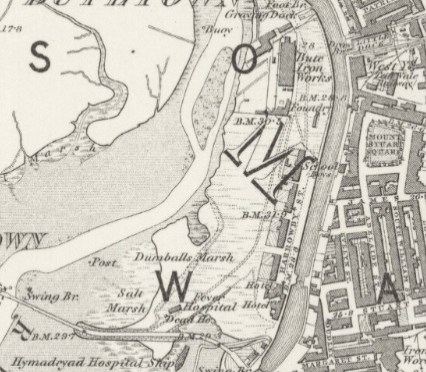
You can’t actually see Clarence Road Bridge in the map below – it hadn’t been built at this point (1879). But roughly halfway down the picture, you can see James Street on the right hand side – imagine that carrying on to the left (westwards) and going straight over the water into Grangetown. That’s the horizontal line we’re talking about, just above where it reads ‘Dumballs Marsh’.
But no, not fine. Writer, poet, historian, all-round good guy Peter Finch has done all of the due diligence with respect to Cardiff history when researching for his Real Cardiff books (recommended reading, students), and he responded to an email I’d sent him asking if he knew where the spot was with this: the general area was right – it was between the Taff and the canal, but rather than being south of where Clarence Road would eventually be built, it was actually north (up towards where the centre of town is): in between that bridge and the timber ponds, on an actual island created by the Taff, oxbowing its way down to the Severn and the sea beyond.
Peter, wonderfully poetic even when answering inane questions from Cardiff bloggers, wrote me this:
The Taff has always moved about. Thrashed about perhaps, as it traverses its delta. Rat Island, as I understood it, was a section of Taff’s bank made an island by the river ox bowing itself. This was upstream of Clarence Road Bridge near The Dumballs. It was formed, according to Mary Gillham, following one of the periodic floods that plagues the Taff. Gulls and other birds nested there. Rats invaded along a revealed at low tide causeway in order to steal their eggs. The land became rat infested. The name followed.
That was Peter’s first email. Isn’t he a gem? Being in a mad rush, as I always am, I misread the ‘upstream’ part and thought he meant downstream …
But there’s a reason for that. All of the folks I asked – people who used to live here, and had the story handed down from parents or grandparents – had heard the area was called Rat Island because of the rats that were disturbed either when the HMS Hamadryad first to the area (in 1866), or when she was finally dragged away to be destroyed in 1905.
@OldCardiffPics Wasn't it named 'Rat Island' after the Hamadryad was broken up? The story we were told was that the rats came from the ship.
It makes sense, but the area being referred to is south of the Clarence Road Bridge: quite a lot further south … and adding to the confusion, I had read somewhere else the area was already called Rat Island, long before the ship came to Cardiff in 1866.
So how does it all fit together?
The discrepancy between the locations – north of the Clarence Road Bridge, versus south?
I raised the possibility of the name referring to an area north of the bridge with the Cardiff Docks Remembered Facebook (where people share memories of the area and discuss such matters) and it was pretty much universally poo-pooed. No way, said people who had grown up around here. Their truth was in the tales from their parents and grandparents, and they had been definitively told. Rat Island was south, the area next to the Sea Lock, that would eventually turn into Hamadryad Park.
We aren’t debating the European Convention of Human Rights or anything here guys. I am well aware this is a long gone name for an area that bears no resemblance to the marshy hinterland that inspired it – but that doesn’t stop me wanting to know WHY, does it??
There is, I think, anyway, a solution to this, that includes all of these seemingly conflicting perspectives and accounts: an ultimate answer that I – Helia Phoenix, non-historian, non-expert, super-nosey local person – will put forward as the only conclusion to this burning issue … this imperative question … that literally no-one – apart from me – is asking …
Where was Rat Island?
Here’s my theory. The entire area that fringes the main urbanised docklands – from the Bute Ironworks all the way to the south and east, where you can see the HMS Hamadryad hospital ship – would have been a muddy, marshy wasteland at that time – its only purpose really to keep people with infectious diseases away from the overcrowded docks and Tiger Bay. There was very little of interest on any of that land – either north of the future Clarence Road Bridge, or south of it.
So … it’s possible that the one spot was originally named ‘Rat Island’ – the small island next to the Ironworks, as pointed to by Peter Finch – but the name spread down (or was re-used) in the south, once the HMS Hamadryad showed up (or was hauled away), spreading its ratty citizens across the undergrowth that is now Hamadryad Park.
HMS Hamadryad Hospital Ship on “Rat Island”, Cardiff. Photo from People’s Collection Wales
I won’t hold out for my Nobel Prize. But I did feel like I might have actually sort of solved something that’s been bugging me for ages.
I emailed Peter asking if he thought this might be possible. He agreed – that there were two things that were getting confused here …
Rat Island, the geographic island, i.e. a piece of land with water on all sides is the place you’ve spotted on your map. This is the one Mary Gillham suggests had birds nesting on it whose eggs were stolen by rats. Then there’s the local name for the whole district. Bill Barrett who died in 2013 and who was writing his piece on Rat Island for the Cardiff Book #3 (Stewart Williams Publishers) in 1977 suggests that all the land between the canal and the Taff was known as Rat Island. He suggests that this went as far north as the Timber Ponds. These were where the Iron Works are shown on your map … it does seem to be probable that the whole slab of land took on the name of the island.
So, Bill Barrett (RIP) might have got there before me. I wasn’t able to find a copy of his book anywhere (I’m on the lookout – please tell me if anyone finds one), but I’m happy enough with the result.
I did a lot of research for the initial piece (though it might remain inconclusive…), so if you’re interested in further reading:
The Cardiff Coal Boom: The Chronicle Radio show (featuring Ian Hill from Save the Coal Exchange, author / historian Neil Sinclair, Juliet Lewis – Senior Lecturer at the Welsh School of Architecture), broadcast February 2017
Not really relevant for this piece, but lovely to follow if you’re on Twitter: @OldCardiffPics
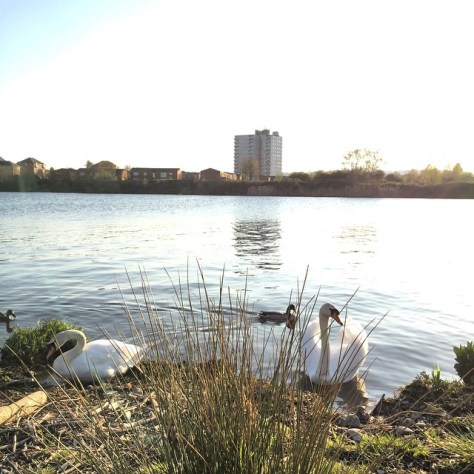
Images in this piece: both taken on the section of the Taff that runs through the now disappeared Rat Island: Instagram malayabbasi and heatherpatterson.
Have you been to one of Cardiff’s seemingly endless array of vegan festivals yet? We sent student Maika Wagner along to Viva Vegan to dish the dirt. Not literally. The food actually sounds totes delish there.
My interest in veganism is personal, as I became vegan for health reasons about four years ago. In between I had a stretch of being vegetarian. It wasn’t until later that I started to think about the treatment of animals etc. I think it’s important to promote veganism in a peaceful way instead of the militant way some vegans go about it. It’s important for people to see that it is not as hard as they think to be vegan and that one person can make a difference with their diet, not just to the animals, but also for themselves and their health.
My neighbours had a stretch of being vegan back in 2012, and at first I thought it was quite extreme, because I did not get the motivation behind it. At some point I was looking at weight-loss diets and found this one book by Attila Hildmann. My neighbour had it, so I tried the 30-day challenge and stayed vegan afterwards, as during that time I had read up on all the animal cruelty and it just didn’t sit right with me.
There have been many vegan festivals going on in Cardiff throughout the last year, this most recent one looked like it might be the biggest one yet: The Viva Vegan Festival.
Having been held at the City Hall this Saturday, the Viva Vegan Festival attracted quite a few people who were interested in veganism or were already vegan. The entry fee of two pounds seemed reasonable enough for passers-by to give it a go. Being held in City Hall gave it a more official feeling than other vegan festivals in the city that I had been to. For £14 pounds, you could even have booked a VIP ticket in advance and get a goody-bag and also, most importantly, jump the queue.
If you didn’t fancy splashing out, there were some food trucks outside City Hall so you could have a taste of what was inside.
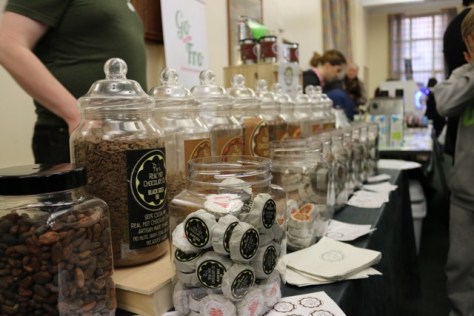
The stalls featured at the festival were very diverse, ranging from different foods, over bath accessories, skin care, makeup, clothing, art etc, all the way to animal rights activists. Most of the stall-holders were not Cardiff based, but can be found online.
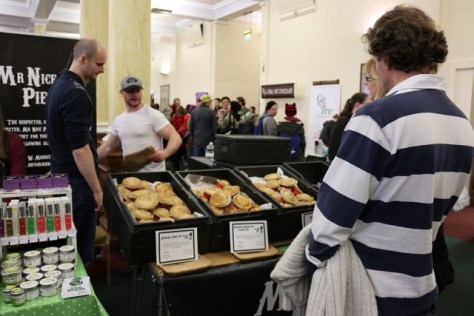
My personal favourites were Solkiki, Bohemian Chic Minerals, chaaboo and Flavour Fusion. However, the all-time favourites with the masses are Mr Nice Pie and The Vegan Bakery.
Solikiki is the most amazing raw chocolate (my favourites are his white chocolate salted peanut and white chocolate hazelnut). The chocolates are Fairtrade and it is ensured that a large amount of the profit goes directly to the farmers.
Bohemian Chic Minerals makes mineral makeup for extremely sensitive skin. Every product is hyper-pigmented, so a even though the tubs are small, they will stretch for quite a while.
Chaaboo makes amazing, cold-pressed, hand-made soaps. There are different scents and two different sizes, which allows one to buy a small hamper of test-soaps as a cute, cruelty-free gift. My favourite scent is the green-tea soap. Many people don’t realise that soap is often made from animal fat and it is nice to have an alternative without having to check the label.
Flavour Fusion is a sort of ‘vegan parmesan’, made from almonds and spices. You can either sprinkle it on top of food or mix it with some olive oil for a dip or pesto, for some amazing flavour.
Apart from the stalls, there were also a variety of vegan talks and vegan cooking-demonstrations going on throughout the day, such as Jane Easton’s baking demonstration. She is the author of the Viva vegan cookbook and gave some great tips on baking, while also doing some myth-busting along the way.
I was born in Cambridge, but raised in Hamburg, Germany. Hamburg was probably one of the first cities to have a completely vegan supermarket. A lot of the vegan foods found in the UK are currently being imported from either the US or Germany, so it’s funny to be in a store here and start reading out german labels. There’s a district in Hamburg called Schanze. It’s the hip, young district and has a ton of vegan options, including a vegan ice-cream shop, which is amazing. But you’ll usually find vegan stuff even in normal supermarkets, although more limited than a health-food store. Also, many of my close friends in Germany are vegetarian or vegan, so it’s really easy when going out or going round each other’s houses.
Maika Wagner is 21 years old and was born in Cambridge, UK, but moved to Hamburg, Germany when she was five. From 2010 to 2011, she was on an exchange year in Lecce, Italy, learning the language and getting to know the people there. She moved back to Cardiff to study and is currently on her third year of Contemporary Music Performance at the Atrium.
Culture vulture Catrin Greaves rounds up Cardiff’s art gallery highlights for February. Take it away, Catrin!
Nature’s Song, National Museum of Wales, Cardiff
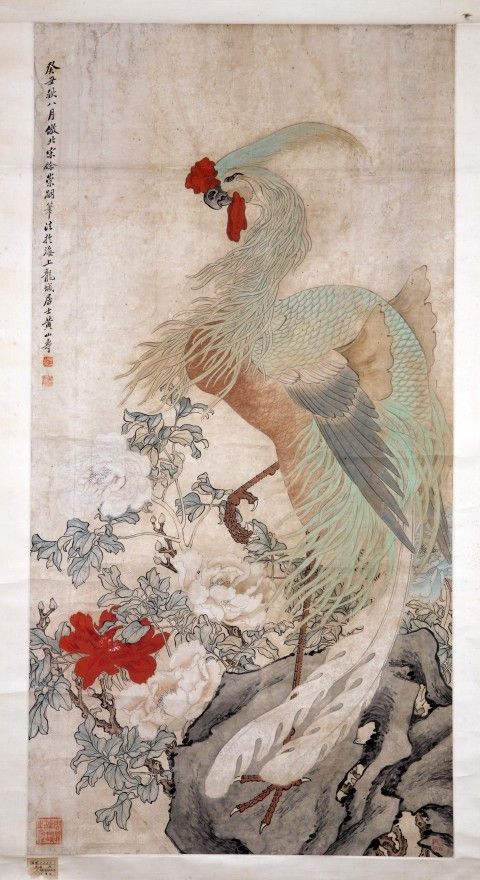
The museum hosts a stunning display of traditional Chinese bird and flower paintings, the first time this collection has been seen in the UK. Nature’s Song traces the development of this art form from the late Ming dynasty (late 16th century) to contemporary interpretations from recent decades. Bird and flower paintings showcase the talents of poets and calligraphers, as well as painters, and the exhibition emphasises the symbolic and spiritual meaning of bird and flower motifs.In the exhibition, you can learn about different techniques used by painters and calligraphers to create these stunning artworks. This is an exciting opportunity to sustain links between Wales and China: the exhibition has been created in collaboration with China Three Gorges Museum in Chongqing. On until 23 April.
Anna Noel is inspired by how animals accompany humans throughout our lives. Based in the Gower, Anna takes inspiration from the animals she grew up with: From fairy-tale figures and imaginary friends to trusty companions and beloved pets. Noel creates charming ceramic figures, set to populate the Craft in the Bay from 21. January 2017 – Sun, 5. March.
The artist group X-10 present the outcome of two years of collaboration, where they examined the closure and decommissioning of Wylfa on Anglesey, the last nuclear power station in Wales.Through video, photography, sound, sculpture, and installation, the artists respond to this event and question the future of nuclear power and attached environmental concerns. Merging art, science and technology, the show adds new questions and thoughts to the nuclear debate. On from 18 Feb – 17 March 2017.
Participating artists include, – Ant Dickinson, Bridget Kennedy, Jessica Lloyd-Jones, Chris Oakley, Teresa Paiva, Tim Skinner, Robin Tarbet, Alana Tyson, Annie Grove-White, Helen Grove-White.
Don’t miss the Artes Mundi exhibition at the National Museum of Wales and at Chapter, which finishes on February 26. Cardiff-based organisation Artes Mundi is best known for its biannual exhibition and prize, and emphasises how art reflects what it means to be human in contemporary society – it is the largest cash prize awarded for the arts in the UK and one of the most significant in the world.
This year’s exhibition brings together the work of shortlisted artists from Lebanon, Angola, Algeria, the USA, Ghana and Wales. It showcases work in a variety of media, including film, installation and performance art. Pop into the galleries for a free guided tour (2pm daily at the museum, and on request at Chapter), and keep an eye out for free family drop-in activities over February half term, which will examine themes inspired by the artists’ work, including costume, storytelling and gardens.
Catrin Greaves works as a tour guide and workshop facilitator at the National Museum of Wales. She moved to Cardiff after studying Anthropology in Belfast, and enjoys singing ina choir and doing embroidery
This is a piece put together by Lucy Thomas, Course Leader in BA Music Business at University of South Wales. She published it before Christmas on her LinkedIn and has very kindly allowed us to republish.
Finding myself with some rare time over Christmas I have taken the opportunity to write up a post inspired by some unknown family photos my mum recently shared with me. For the last few years I have been musing concepts of entrepreneurialism, creativity and the nature-nurture debate. It is not my favourite word and I’m not sure exactly what it means, but roughly it’s about new ventures and ideas. The attached photos were a wonderful discovery and have gone some way in confirming my thoughts.
Is entrepreneurialism something that can be taught or is it more of an innate, sixth sense that individuals are born with? Do some people just have the X Factor for new business generation? Obviously, most skills can be learned to some extent, but it is apparent that there are “natural entrepreneurs” who thrive in new landscapes. The traits of individuals wired this way are evident from a young age and at the very heart of it, I see the motivation as creativity and social connectivity. Interaction, expression, the bringing together of things is the driver and pleasure here. It is often the norm for profit to be the secondary result of an excellent service or product. An affirmation of value and not always the main focus as non-entrepreneurs may think.
What has led me to this point has been my own experiences coupled with observations of my oldest son and his friends over the last few years. From the age of about six he genuinely loved nothing better than setting a stall up in the front garden so he could sell, barter, exchange and most of all interact. We then moved to the coast and things got really exciting when the sun shone, people were thirsty and there were tourists. We literally had camper vans pulling up outside and kept running out of stock.
Some young children would rather eat coal than talk to a stranger, or tout a new idea, but our boy just loves to hustle. Fast forward to his dads Street Food projects there is a smoothie stall being incubated along with growing frustration that he’s only 10 and can’t go it alone just yet. We have neither encouraged or discouraged, he’s just been running with his own plans and I have learned that this is the way it is with kids. They have their own ideas no matter what yours are.
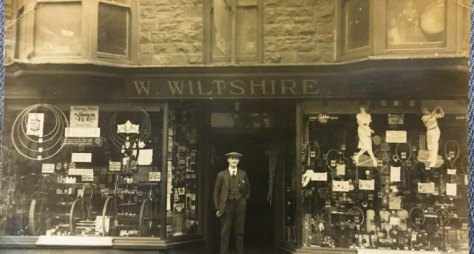
Just recently we found these photos of my Great Grandfather’s shop in Pentre selling all kinds of things including bikes and records. I love the way it’s called “W Wiltshire – Athletic, Cycle, Gramophone, Wireless and Electrical Depot”. Anyone who knew the record shop I had for 21 years in Cardiff called Catapult will probably laugh at the many similarities between my business and his, despite the hundred years or so age gap. After completing law school the path I choose at 24 was not that of a solicitor, but an unknown one in self-employment and dance music. Catapult was a launchpad for a label, events, DJ school, lecturing, fashion line and community venue. There is no set career path once you go it alone and this is the best bit.
There can be misconceptions in the ways these “going aloners” or entrepreneurs are perceived and it is particularly difficult for creatives to connect with concepts of business and profit, almost as it if devalues the authenticity of their work. An ugly monster of commercial manipulation, materialism or some such other hideous proposition. The reality is that all new ventures are exciting start-ups to be explored whatever the context and this includes creative projects, music and art. The art of business in itself is an imaginative process; an adventure where you dig deep to collaborate, diversify, adapt and ultimately survive.
Increasingly I see the entrepreneurialism term popping up in the educational sphere and indeed it was a Foundation Degree in Music Industry Entrepreneurship that drew me to the University of South Wales in 2012 and precipitated a career change in lecturing. I found it amazing that people could actually gain qualifications in this sector and was curious to decipher the curriculum processes. What I have found are innovative, transferable skills and environments where you can test things out, including yourself. There are definitely natural entrepreneurs engaging with the process, as well as more reluctant innovators, who sometimes find out to their surprise that they like this stuff.
I am aware that this is a very personal account, really just scratching the surface on a subject I’m keen to research further. Very interested in feedback and shared experiences.
Footnote Jan 2017…. Since writing this post a number of people have been in touch (thank you) with information about W.Wiltshire, including this advert from the Rhondda Leader Newspaper 1917. This has enabled me to date more accurately and I’m blown away that Catapult and Wiltshire’s shops co-existed over a hundred years apart! I love the tone of the advert; the way in encourages saving money by riding bikes in a bid to push the brand. Entrepreneurialism and Wales are in my blood more than I know.
Student journalist Ellie Philpotts writes a guide to Cardiff – for freshers!
Here at We Are Cardiff, it’s fair to say we’re fans of … Cardiff. Some might even say we are Cardiff. Not even just those of us writing away, although the name kind of suggests that. The beauty of Cardiff is that we are all Cardiff – the people make the city what it is. Whether you’re in your first term at Cardiff University, Uni of South Wales, Cardiff Met or the like, or have never strayed further than the Welsh capital in all your years, you’re sure to appreciate that Cardiff is full of friendly faces.
While lots of people come together in forming Cardiff, right now we’re focusing on one group of Cardiff’s people – new students. Now it’s November, you’ll have had a couple of months’ prime time to work your way around it, but it’s still early days compared to how long you’ll be here, so here are Ellie’s top tips on how to make the best of this exciting city.
Cardiff’s Best Places for Coffee
Alliteration isn’t the only thing Cardiff and coffee have in common. They also happen to compliment each-other perfectly. So if you’re in urgent need of a generous dose of caffeine to tackle your 9am or are after a more leisurely location to whittle away a South Wales Sunday, you’ll have plenty to choose between.
But as impressive as each of these are, Cardiff’s coffee scene isn’t restricted to the centre. Walk a little further afield and you’ll stumble across these:
Rose Street Flea Market – another alternative shopping location for a student budget
If you wish it was socially acceptable to place ‘Shopping’ in the ‘Interests’ section on LinkedIn, you’re in luck living in Cardiff. As with any city, the big names line the centre, most notably Queen Street; St Mary Street and Queen’s Arcade, but the Arcades trailing through the city are certainly unique to Cardiff. Bookworms, foodies, vintage lovers, fancy dress fans, bargain hunters or just those who fancy a good hair cut all unite. Other hidden gems include Jacob’s Antiques; Castle Emporium; and an array of quirky charity shops in areas such as Cowbridge Road East and Albany Road.
Cardiff’s Best Lunches
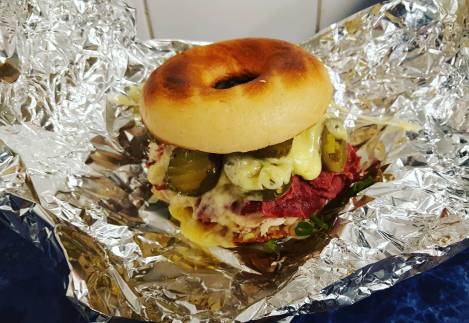
A delicious bagel from the New York Deli
Studying is hungry work, but you don’t need to demolish your student loan to have a good lunch. The cheap and cheerful crème de la crème in the city centre span from New York Deli, High Street Arcade’s legendary take on the Big Apple (fruits don’t actually always feature in the Hoagies and bagels); The Real Italian Pizza Co (the authentic pizzeria recently set up camp on Church Street having expanded out of Bath); Nata & Co, a charming Portuguese bakery opposite the castle but also found in Splott and the Bay; and 29 Park Place, a colourful and fun welcome addition to Park Place, otherwise known as Cardiff University’s Student High Street.
Meanwhile, the Roath/Cathays border offers its fair share of good grub if you’re not up for venturing too far from student territory – highlights include The Pot’s quaint sister branch, Arty’s Kitchen; Anna-Loka, Cardiff’s first 100 per cent vegan cafe; and New York Diner, the new (York) kids on the City Road block who know how to serve up a mean burger and milkshake combo.
Cardiff’s Best Nightlife
Good times at Buffalo
With something (or multiple events) on every night of the week, ‘bored’ soon becomes axed from the Cardiff student’s vocabulary. From Bump ‘n’ Grind at legendary bar Buffalo to the somewhat iconic Live Lounge and the chain of nationwide-recognisable clubs like Glam and Pryzm, there are plenty of opportunities to belt out some 90s classics, but on the quirkier end of the spectrum are Clwb Ifor Bach; Chapter; Dempsey’s and Millieu’s Spoken Word nights.
Cardiff’s Best Parks
Not many cities can say they’re in such close proximity to what more resembles the middle of nowhere. And even if they could, we’re still going to praise Cardiff’s park culture. You’ve probably by now tracked down Cathays Park (right next to Cardiff University), just a stone’s throw from Bute Park, but did you know it’s not just under the shadow of the castle? One of the UK’s largest parks, it covers 130 landscaped acres, leading all the way towards Llandaff down the Taff Trail.
Meanwhile, Roath Lake is the heart of the community-centric suburb of Roath, with its stunning botanical gardens beautiful whatever the season. If you’re feeling brave enough in summer, rent a pedalo, or hibernate in Terra Nova cafe if the Cardiff rain is doing its usual thing.
Trek slightly further out though and you’ll find Canton’s Victoria Park; the grounds surrounding St Fagans Museum; or abandon the constraints of inner Cardiff altogether and reach Cosmeston Lakes to the south of attractive seaside town of Penarth; the Knap proving Barry is so much more than Gavin and Stacey; the Brecon Beacons’ peaks and waterfalls; or the Bay’s Barrage walk.
As rambling should be reserved to South Wales’ actual countryside, I’ll wrap it up now – but all in all rest assured that if you’re new to Cardiff you’ve made the best decision. With a thriving cultural scene; opportunities all round; the prime balance between nature and urbanisation and the chance to try your hand at skills you wouldn’t have ever thought of, Cardiff has it all.
Ellie Philpotts is a student at Cardiff University studying English Literature, Journalism and Media. She is a teenage-cancer survivor; is obsessed with travelling, and her favourite cities outside Cardiff are being Sydney, NYC, Nashville and Paris. Her ‘likes’ also include general Britishness, cups of tea, exploring, attempting to write songs, journalism, Italian food, finding new places, going out for dinner and taking photos – of everything. She is not a fan of maths, mashed potato, narrow minded people, her phone constantly running out of memory for photos, or people who are mean about Taylor Swift. Follow her blog or Instagram.
Today we’ve got a mini feature, around the work of photojournalist Aiyush Pachnanda. Aiyush is focusing on Cardiff and its vibrant night scene for a current project …
“I am from London but moved to Cardiff to study photojournalism at the University of South Wales,” says Aiyush. “I chose to study this because I want more than just a photo, I want to portray the story behind the photo.”
“My favourite thing about Cardiff has to be how compact everything is, coming from London everything is just so far away from each other and just having the ability to walk from one end of the city to the other is great. I also love the nightlife of course. I fell in love with night life culture, ever since I arrived and as photojournalism student I just wanted to document that, photograph what I see and the people I come across.”
Love, Cardiff is the story of our city’s past, present and future told through the personal accounts of our City Road communities. The customers in the barbers and take-aways pass each other on the street. The staff in the grocers, the sex shop, and the funeral directors sit side by side on the bus. The residents of City Road make their way home, every passer-by, every person an extraordinary story.
Love, Cardiff is a community production that explores the stories that lie behind the faces of those who live, work and play along this vibrant city road.
Do you have a City Road story?
If so, get in touch. Your story may be the inspiration we are looking for to help us build our performance, exhibition and archive. Please contact the Love, Cardiff Team on 02920 646980 or email love.cardiff@shermantheatre.co.uk The Community and Engagement Team at the Sherman Theatre create projects about you, our citizens, together telling the story of our community, our capital city.
‘To have the whole community in a play made entirely of their words was incredible.’ (Waulah Cymru Committee Member on the Sherman Theatre’s Community Production of Home)
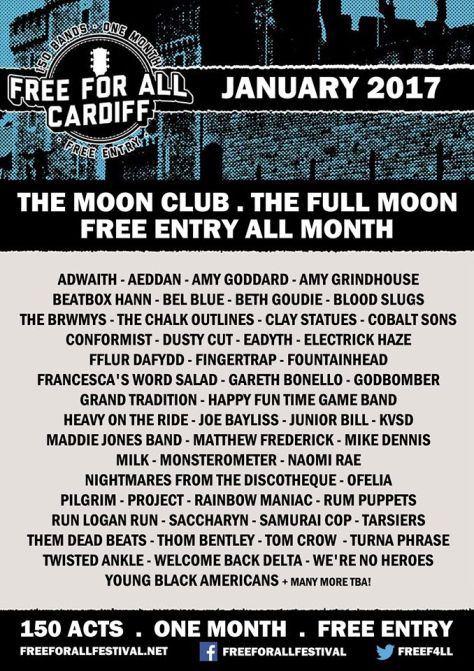
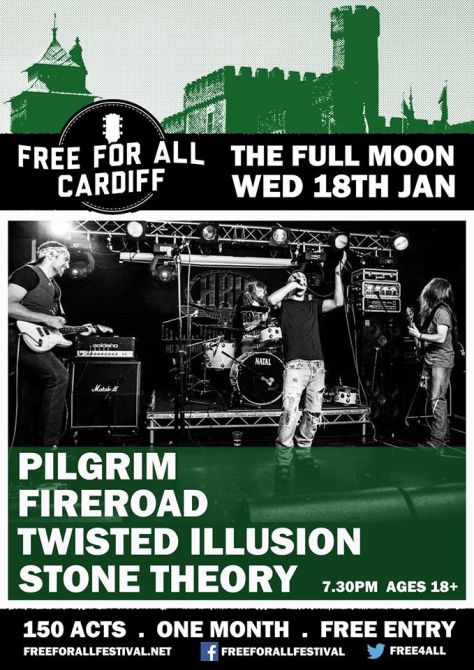
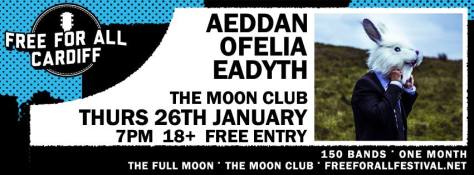
Is it over? Has it finally finished? Has someone finally dragged 2016’s lifeless body out to the garden and buried it under a mountain of Leicester City and Nigel Farage memorabilia? Great, well let’s all collectively repress our memories of 2016 together with Free For All Festival running from 5 January to 31 January at The Moon Club + The Full Moon. They have kindly put on a month of free events – so don’t worry if your pockets are empty like the rest of us – with bands and artists of varying descriptions, so give your eardrums a treat and pop down to The Moon Club + The Full Moon and support these artists.
The event runs from 5 – 31 January, so if you’re gagging for an all-dayer or fancy checking out some local talent see the array of events on below.
Tuesday 10 January, 8PM
Downstairs: 6foot7 + Paul Divers & support 8pm
Friday 13 January, 7PM-10PM, 8PM-late
Upstairs: Electronic Music Wales showcase feat. Skeleton House & support 7pm-10pm
+
The Black Hole Of Womanby St feat. Samurai Cop + DJs til late
Downstairs: Monsterometer + Godbomber 8pm Friday 13 January Facebook event
Saturday 14 January, 5PM + 8PM
Upstairs: Maddie Jones – Band + Lilygreen’s Sky Machine + Instructions + Tobias Robertson + Charlie Says 5pm
Downstairs: Mike Dennis + AcouMetal & support 8pm
Sunday 15 January, 7PM-10PM + 6PM
Upstairs: Staylittle Music presents Beth Goudie + Joe Bayliss + Matthew Frederick 7pm-10pm Follow the event on Facebook
Downstairs: Timeless Promotions + Beast PR + HOPE not hate + Decidedly Records present Gareth Bonello (The Gentle Good) + Vinna Bee +Francesca’s Word Salad + Adwaith 6pm Follow the event on Facebook
Sunday 22 January, 2PM
Upstairs: RecRock Youth Music Project showcase 2pm (Ages 14+)
Downstairs: Pi & Hash Music alldayer feat:
Them By There + The Sam-Antonio Freeway + Thee Manatees + Siblings Of Us + Charlie Says + Canada Road & support. 2pm-11.30pm
2-floor alldayer! Tibet + Junior Bill + The Chalk Outlines + M I L K + Shop Girls + Them Dead Beats + Nevsky Perspective (solo – performing the works of Britney Spears) + Thom Bentley & more TBA. 4pm
Sunday 29 January, 2PM
Forté Project // Prosiect Forté showcase – 2 floors! 2pm (Ages 14+)
Showcasing the 10 acts announced as part of the Forté Project scheme.
Monday 30 January, 8PM
Upstairs: CitySound Publications – magazine launch night feat. CHROMA & support 8pm
Downstairs: Anonymous Iconoclasts + Capra Mamei & support 8pm
That’s all the free music and events you can partake in at The Full Moon + Moon Club this month, so be sure to get on down there and support your local scene. Even when your pockets are empty and the January cold bites a little harder than you remember, there’s still a way to support your local scene and – most importantly – your city. Be sure to check out some of these events as they are putting a lot into Cardiff, so it’s only fair for us to give back.
Oh, and have a fun, crazy, challenging and memorable 2017.
Arcade and competitive gaming – at its core – is a social activity, one that flourishes under the influence of beer and alcoholic hedonism. Interestingly enough, however, Cardiff has yet to have an arcade or bar that appeals to this dream combination. Retro-fetishism has had something of a renaissance period in the past few years, yet Cardiff hasn’t really jumped onto this social trend.
There’s been a huge gap in the city for an arcade for a while and Kongs – given the success of their branch in Bristol – has seen this gap as an opportunity to combine this niche with one of Cardiff’s great loves: bars. The nonchalant exterior of the bar can fool many, a few short steps down and suddenly you’re submerged in a basement of neon signs and 8-bit classics.
The food and drink at Kongs offered something a little different than traditional pubs on St. Mary’s street. Lesser known lagers such as Red Stripe and beers like Blue Moon were popular amongst the pint sippers of the bar, whereas the food offered tasty and interesting twists on traditional pub food (the BBQ burger was a real treat). Craft beer, too, was popular on tap, so that’ll appeal to all you beard waxing craft beer aficionados out there. Pricing was similar to the rest of the pubs on St. Mary’s – i.e. a little on the pricey side – but this is to be expected for such a popular street in Cardiff.
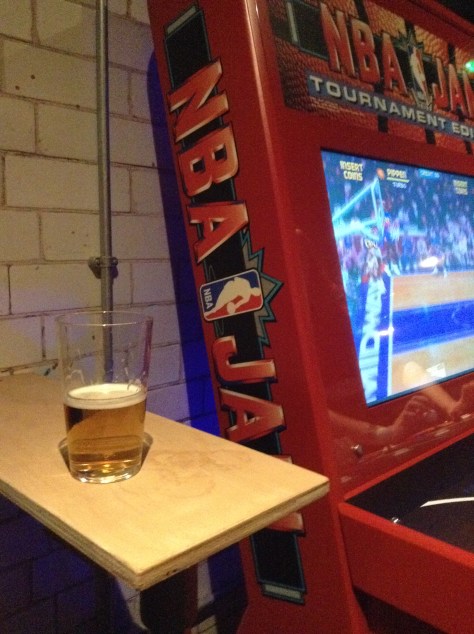
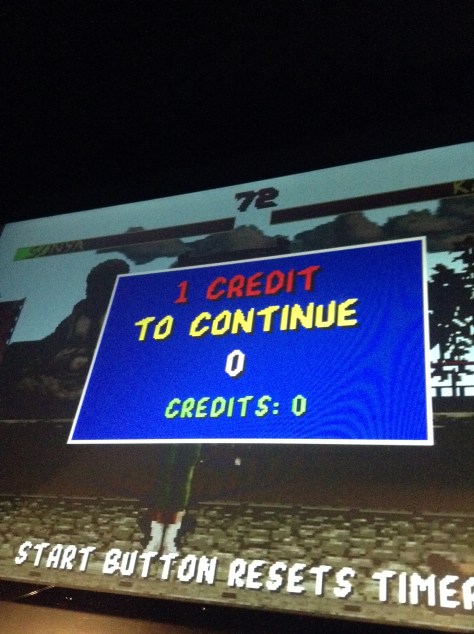
Of course, what matters most at Kongs are the games. Classic arcade games such as Street Fighter II, Mortal Kombat, Donkey Kong and Pac-Man got the most attention at the bar. What I liked about Kongs was the sheer array of arcade games available. Outside of the staples mentioned, you could also find things like OutRun and NBA Jam, too. The majority of the games had a competitive edge, and were suited to a social setting: everything in the bar was geared towards promoting good-natured competitive gaming, an ode to the unique gaming social culture of the arcade era. In case you’re interested, prices were £1 for 2 credits.
The bar, overall, struck a good balance between social drinking and dedicated gaming. Kongs proved to be an exciting collage of conversation, drinking and combo-punching, an experience that was original in comparison to the growing homogeneity of St. Mary’s.
The major question about Kongs is whether it can sympathise the gaming bar niche with the boozy nature of St. Mary’s Street, but judging by the success of their Bristol branch they should have no problem finding a clientele itching for a game of Street Fighter II over a pint. Bars like Koopas and 8-Bit Bar have been huge successes in Swansea, so why not Cardiff?
Photojournalist Ben Blyth spent a night sleeping rough, speaking to street homeless people in Cardiff to hear their stories and to find out how they would like to be treated by the public.
Ben talks to us about the process of putting the film. First, if you haven’t seen it …
Here’s what Ben had to say about putting the film together:
“My interest in homelessness has been one that started back in 2014, when I started a project photographing Cardiff’s homeless and attaching quotes to the images from the people in them. However, after another year of studying since, I have realised that I didn’t even touch the tip of the iceberg. So when I was given the opportunity to create a film for one of my final year assignments, I felt that this was the chance to revisit the subject and try to cover it in a way that offers a fairer view on homelessness in Cardiff.
“I began creating this film in October, and had decided that to not go into the subject completely blind so spent two days and a night sleeping rough and begging on the streets of Cardiff. I had originally planned to spend two nights sleeping rough, but to be quite honest, at the time I couldn’t bring myself to do another night. This is partly down to being woken up multiple times in the night by drunk people and then in the early hours, the police woke me to see what was going on. This however was a minor part of the experience, I felt completely lost in a city that I had lived in for two years, a feeling that is very hard to explain, but when there is literally nothing to do or no where to go, its a very confusing feeling. During this experience, I realised very quickly that I would never have any idea of what it’s like to be homeless unless it actually happened to me, this is when I started to talk to homeless people in the city, firstly without a camera, just chatting to them and seeing what they thought of the idea of a film. Most liked the idea, and with that I began filming.
“The main aim of the film was to let the people on the street respond directly to comments often seen online directed at homeless people. These came to my attention even more after my experiment and really angered me, especially when most homeless people don’t have the chance to respond for themselves. The outcome of this is the film, A Little Change, Please. The message I received from most of the people I spoke to on the streets was that, they would much prefer someone to sit and talk to them for a few minutes than have a little bit of change thrown at them. Yes, the money and food is important, but what is more important is that they are made to feel like people, this can be so much more important than a couple of coins. From the response so far it seems to have changed quite a few opinions, and I feel this is important. No one individual can stop homelessness, but if everyone makes a little change to the way they see them or treat them then the bigger change has more of a chance of happening.”